

Mexico’s Interoceanic Corridor: The Rail Route Reshaping Global Shipping in 2026
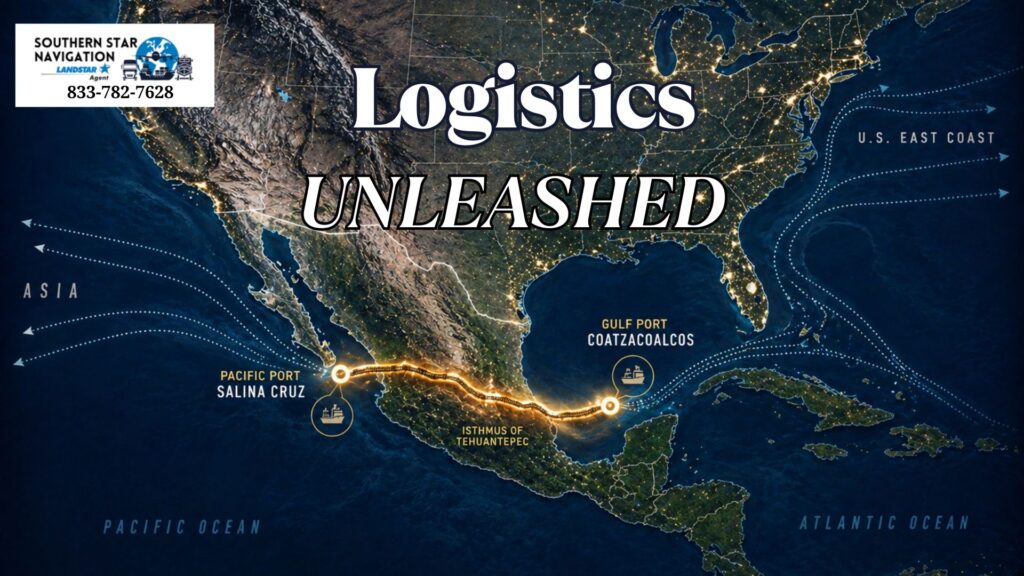
A Second “Panama Canal”? Why Mexico’s Land Bridge Is Getting Real Attention in 2026
Global shipping is going through a shift that is hard to ignore.
For years, most cargo moved through a handful of major routes. That system worked well when everything was stable. But over the past several years, that stability has been tested in ways few anticipated.
Water levels have limited how much traffic can move through the Panama Canal. Ongoing tension in key regions has raised concerns about major oil and cargo lanes. In other areas, vessels have been forced to reroute entirely, adding time and cost to already tight supply chains.
Because of this, companies are starting to think differently. Instead of relying on one primary route, they are looking for options. Not as a backup plan, but as part of their everyday strategy.
One of those options getting more attention is Mexico’s Interoceanic Corridor of the Isthmus of Tehuantepec, known as the CIIT.
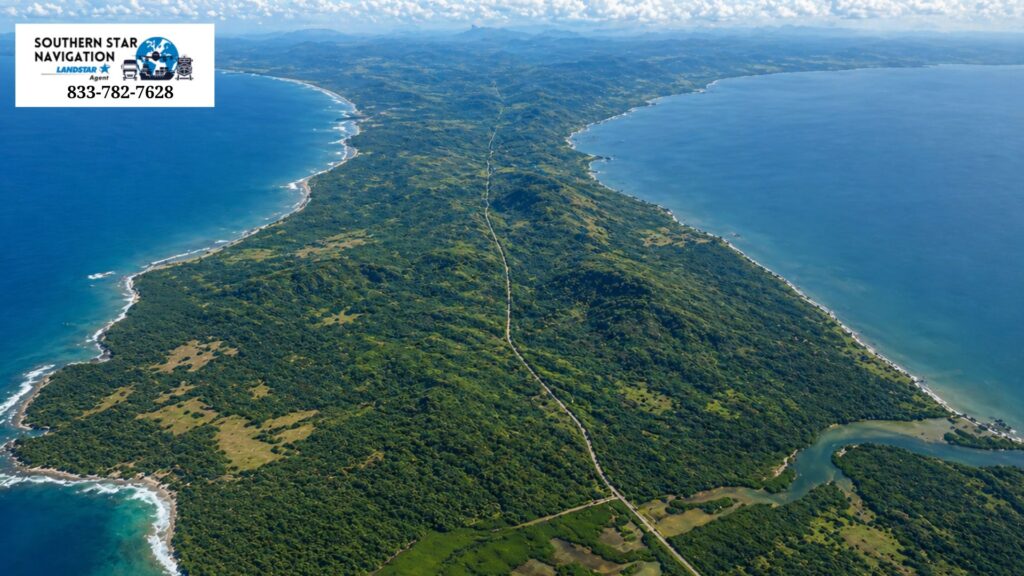
What Mexico Is Building
The CIIT connects the Pacific Ocean to the Gulf of Mexico using a modernized railway rather than a traditional canal. On one side, cargo moves through the Port of Salina Cruz in Oaxaca. On the other, it connects to the Port of Coatzacoalcos in Veracruz.
Containers and cargo are unloaded from vessels, transported across southern Mexico by rail, and then loaded back onto ships on the opposite coast.
It is a different approach compared to a traditional canal, but it serves a similar purpose. The key difference is how that movement happens, and what that difference means in practice.
The project is formally known as the Corredor Interoceánico del Istmo de Tehuantepec. It was officially approved in June 2019 under then-President Andrés Manuel López Obrador and is managed by Mexico’s Secretariat of the Navy, which also provides security operations across the corridor’s four-state territory of Veracruz, Oaxaca, Tabasco, and Chiapas.
A Route With a Long History
It is worth noting that this is not a brand-new idea. The Isthmus of Tehuantepec has been recognized as the shortest land crossing between the Pacific and the Gulf of Mexico for centuries. A railway across this same route was actually completed in 1907 under President Porfirio Díaz and carried over 850,000 tons of cargo in its first six years of operation. It fell into decline when the Panama Canal opened in 1914 and the Mexican Revolution created instability throughout the country.
The current CIIT project is a rehabilitation and major modernization of that original route, not a new corridor built from scratch. That context matters when evaluating both its potential and its challenges.
How the Corridor Works in Practice
This is not a direct sail-through route.
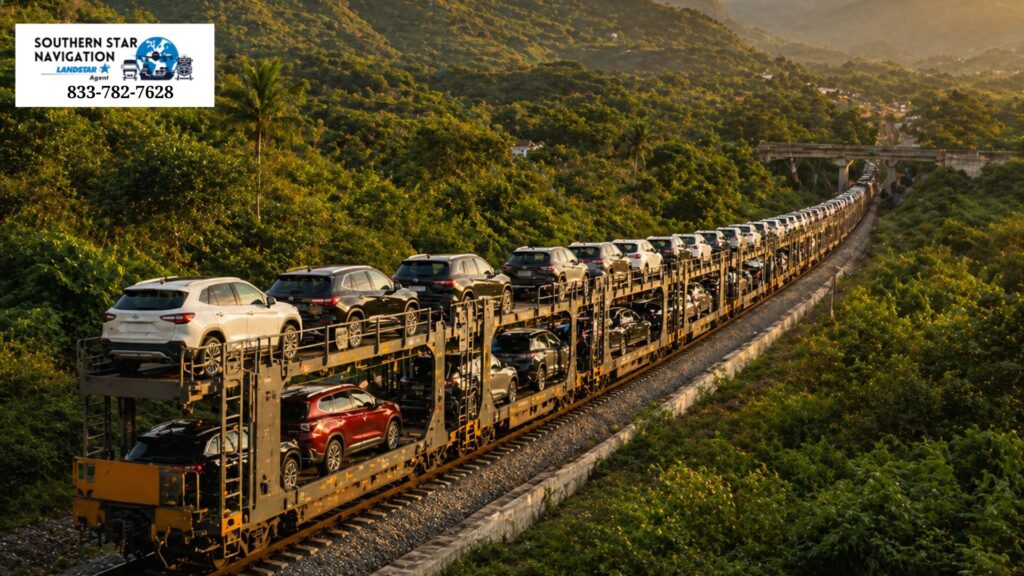
When a vessel arrives on the Pacific side, containers or cargo are discharged at the port of Salina Cruz. From there, they are placed onto railcars and transported across the isthmus. Once they reach Coatzacoalcos on the Gulf side, they are loaded onto another vessel to continue their journey.
This adds a few extra steps compared to a canal transit, but it also removes dependence on a single waterway.
The main rail line, known as Line Z, runs 303 kilometers between the two ports. In spring 2025, Hyundai and its logistics subsidiary Hyundai Glovis completed the corridor’s first major international cargo test. Between March 28 and April 3, 2025, the car carrier Glovis Cosmos delivered 900 South Korean vehicles to Salina Cruz. From there, those vehicles were loaded onto 50 specially designed freight wagons and moved across the isthmus in roughly nine hours. At Coatzacoalcos, they transferred onto the vessel RCC Africa for the final leg to Brunswick, Georgia. The entire ocean-to-ocean transfer was completed in approximately 72 hours, cutting five days off the Panama Canal routing and reducing logistics costs by about 15 percent.
That tradeoff between the extra handling steps and the time and cost savings is exactly why the corridor is getting serious attention.
Why People Are Calling It a “Second Panama Canal”
The comparison comes from the idea of connecting two oceans through a shorter path.
But it is important to keep expectations realistic.
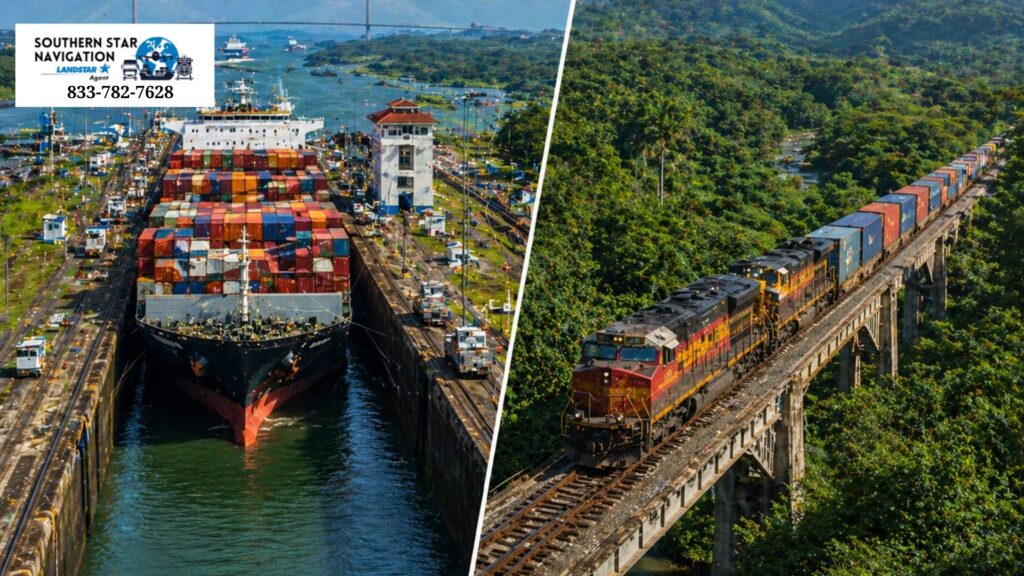
A canal allows ships to move straight through without unloading cargo. Mexico’s corridor requires handling cargo at both ends, making it operate more like a coordinated multimodal logistics system than a direct passage. Mexican officials and industry groups describe it as a “dry canal,” and that is a fair description.
It is not designed to replace the Panama Canal. The Panama Canal handles roughly 8 million TEUs annually across approximately 14,000 vessel transits each year. Even the most optimistic long-term projections for the CIIT target 1.4 million TEUs annually, and industry analysts note that figure would not realistically be reached until 2033 at the earliest, assuming port capacity, rail throughput, and customs infrastructure all come online on schedule.
The value is not in replacing existing routes. It is in having another path available when conditions make traditional routes less reliable or more expensive.
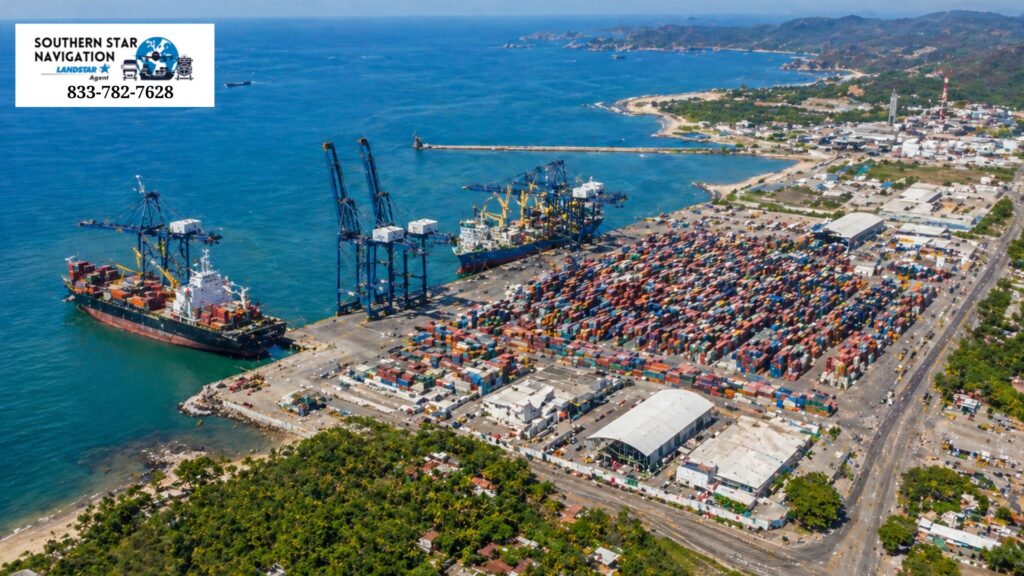
Where the Project Stands Today
This is not something still years away from reality.
Rail freight service on Line Z began in 2023. As of early 2026, the CIIT is a functioning multimodal trade route, though not yet fully operational at scale. In February 2025, President Claudia Sheinbaum confirmed publicly that the full corridor system is targeted for completion by June 2026.
The corridor’s railway network consists of three main lines. Line Z, running between Coatzacoalcos and Salina Cruz, has been fully operational since December 2023 and has transported over 316,000 metric tons of cargo. Line FA, connecting Coatzacoalcos to Palenque in Chiapas, has been active since September 2023 and also connects to the Maya Train network. Line K, which runs from Ixtepec toward the Guatemalan border covering 459 kilometers, was more than 87 percent complete as of early 2026, with its first phase inaugurated in November 2025. Full completion of Line K is targeted for June 2026.
The four CIIT ports, which include Coatzacoalcos, Salina Cruz, Dos Bocas, and Puerto Chiapas, now connect to 82 international destinations and collectively handle close to 20 percent of Mexico’s total cargo movement. Port expansion and upgrades continue at both Salina Cruz and Coatzacoalcos to accommodate container traffic, with a two-kilometer dock at Coatzacoalcos already concessioned for interoceanic container operations.
Ten industrial development zones, known as Development Poles for Well-being, are being established along the corridor in Veracruz and Oaxaca. Eight of those zones have already been awarded through international bidding, with sectors including automotive, medical devices, pharmaceuticals, and metals.
By the end of 2024, the isthmus railway had transported approximately 40,000 TEU containers. That figure is modest compared to the Panama Canal’s scale, but the infrastructure is still being built out and adoption is still in its early stages.
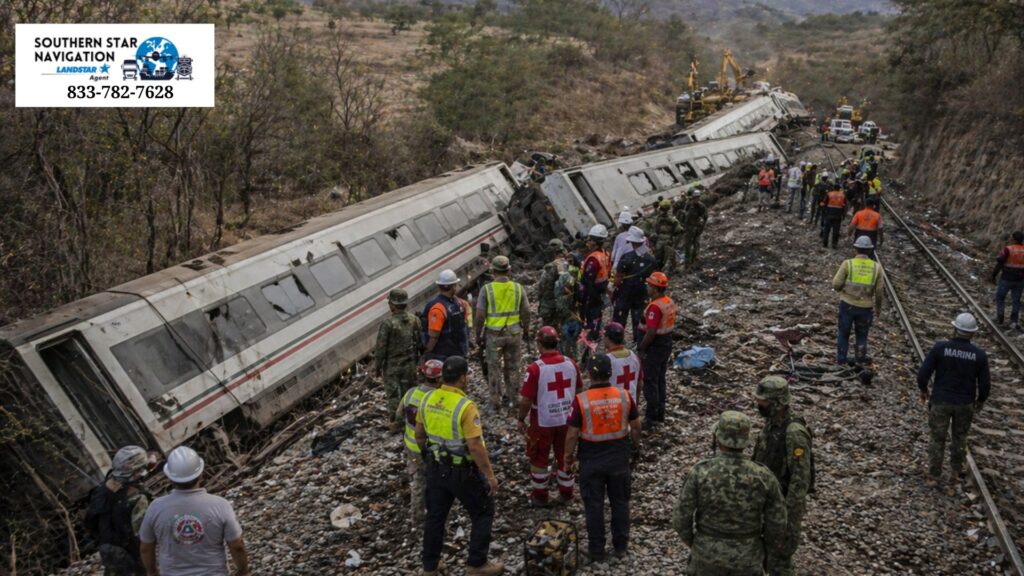
A Major Setback: The December 2025 Derailment
Any honest account of where this project stands in 2026 has to acknowledge a serious incident that cast a shadow over the corridor’s momentum.
On December 28, 2025, an Interoceanic Train on Line Z derailed near the town of Nizanda in Asunción Ixtaltepec, Oaxaca. The train’s two locomotives and four carriages left the tracks. The first carriage fell down a 6.5-meter embankment and the second came to rest at a near-vertical angle. Fourteen people were killed and 98 were injured. The train was carrying 241 passengers and 9 crew members at the time.
Survivors reported that the train had been moving at alarming speed through curves before the derailment. The incident was the fourth safety event on the corridor in 2025 alone.
The accident prompted calls in Mexico’s Congress for independent investigations into construction contracts and raised pointed questions about safety oversight on the military-managed railway. Critics pointed out that the rolling stock in use on the corridor consists of secondhand equipment built between 1976 and 1981, acquired from the United Kingdom and the United States. Opposition senators called for construction and operations to be paused pending a full audit.
The derailment did not halt the freight operations or the corridor’s development timeline, but it did raise legitimate questions about whether the infrastructure is ready for the scale of operations being projected.
What This Means for Capacity and Timing
Transit time for the rail leg of the crossing is roughly nine hours, based on the Hyundai Glovis pilot. The full door-to-door transfer benchmarks at approximately 72 hours. For comparison, under Panama Canal drought restrictions in 2023 and 2024, some routes stretched to 15 to 20 days.
That speed advantage is meaningful in specific situations, particularly for cargo where schedule reliability matters more than minimizing handling costs.
Costs will vary depending on shipment type and routing. There are added expenses tied to the transfer of cargo between vessel and rail on both ends. However, the Hyundai pilot demonstrated approximately 15 percent cost savings over the Panama Canal route for the vehicle shipment it completed.
The current bottleneck is not the rail line itself but port capacity at both ends. As of early 2025, the railway was capable of running approximately four freight trains per day, with a target of eight. Port infrastructure expansion is the key variable that will determine how quickly the corridor scales.
Broader Context: Other Challenges to Watch
The CIIT does not exist in isolation from global trade dynamics.
Mexico imposed tariffs of up to 50 percent on imports from non-trade agreement countries, including China, Brazil, and India, as of January 2026. The United States-Mexico-Canada Agreement is also scheduled for its first formal review since 2020, with that review expected in the second half of 2026. The outcome could materially affect how manufacturers use Mexico as an export platform, particularly in the automotive sector, which represents one of the corridor’s most promising cargo categories.
There are also ongoing concerns from Indigenous communities in Oaxaca and Veracruz about land use and the environmental impact of industrial park development along the route. Some communities have won court rulings that temporarily halted construction in certain areas, and environmental advocates continue to raise concerns about deforestation and habitat fragmentation.
President Sheinbaum has stated directly that even with current tariff disruptions, trade between Asia and Europe will continue and that the corridor remains a priority. Panama’s ambassador to Mexico has also noted that the two routes should be seen as complementary rather than competitive.
What This Route Is Well-Suited For
The CIIT will not be the right fit for every shipment.
It is most useful when timing and schedule reliability matter more than keeping costs at their absolute minimum, or when traditional routes face delays or disruptions. The Hyundai pilot demonstrated that vehicles and other specialized cargo moving between Asia and the U.S. East Coast are a strong fit for this route.
For high-volume container shipping that depends on steady, continuous movement at scale, traditional ocean routes through the Panama Canal will continue to hold significant advantages for the foreseeable future.
Sergio Gutierrez, President of Glovis America, framed the long-term view well when speaking at an industry conference in 2025: “It’s just like when the Panama Canal was created. Many generations were not able to see the benefit, and nowadays we all use it. This interoceanic corridor will be a generational game changer.”
What Businesses Should Be Thinking About
This is a reasonable time to look at how cargo is currently moving and whether there is too much dependence on a single route.
The CIIT offers something real: a functioning, tested route with proven time and cost advantages in specific scenarios, a target completion date of June 2026, and a developing industrial ecosystem along its path. At the same time, it is still scaling, still working through safety and infrastructure questions, and still operating in a trade environment that is being rewritten in real time.
For companies with Asia-to-East Coast routing needs, longer investment timelines, or operations where supply chain flexibility outweighs the premium of more established infrastructure, the corridor deserves serious attention. For high-frequency, just-in-time operations, it is one to monitor and plan around rather than immediately commit to.
Final Thoughts
Mexico’s Interoceanic Corridor is not a quick fix and it is not a replacement for the Panama Canal.
What it is, increasingly, is a real option. The first major international cargo pilot worked. The rail infrastructure is built. Port expansion is underway. The June 2026 completion target is confirmed at the highest levels of the Mexican government. And the industrial zones along the route are beginning to attract serious investment interest.
The questions that remain are about scale, safety, and sustained execution. Those are not small questions.
But in an era when supply chains have learned the hard way what happens when there is no backup plan, having another reliable route between the Pacific and the Atlantic is not a niche interest. It is exactly the kind of option that companies, carriers, and governments are building into their strategies. If you are evaluating how this corridor fits into your shipping plans or simply want to talk through what it means for your cargo, my team at Southern Star Navigation is ready to help. Give me a call at 833-782-7628, Ext. 1.
Sources
- Automotive Logistics Media: https://www.automotivelogistics.media/supply-chain/mexicos-interoceanic-corridor-of-the-isthmus-of-tehuantepec-set-for-completion-in-2026/2586327
- Wikipedia: Interoceanic Corridor of the Isthmus of Tehuantepec: https://en.wikipedia.org/wiki/Interoceanic_Corridor_of_the_Isthmus_of_Tehuantepec
- Wikipedia: 2025 Oaxaca Train Derailment: https://en.wikipedia.org/wiki/2025_Oaxaca_train_derailment
- Mexico Business News: https://mexicobusiness.news/mobility/news/interoceanic-corridor-be-fully-operational-1h26
- SupplyChainBrain: https://www.supplychainbrain.com/articles/42268-is-mexicos-ciit-really-going-to-challenge-the-panama-canal
- Americas Quarterly: https://www.americasquarterly.org/article/mexicos-answer-to-the-panama-canal/
- CNN (derailment): https://www.cnn.com/2025/12/28/americas/mexico-train-interoceanic-intl-latam
- Daily Galaxy (April 2026): https://dailygalaxy.com/2026/04/panama-canal-drought-new-trade-route-interoceanic-corridor/