

Freight Market Update and What It Means for Shippers in April 2026

Global Freight Market Adjusting to Ongoing Disruptions
Global supply chains continue to adjust as geopolitical tensions involving Iran impact key trade routes and energy markets. Activity through the Strait of Hormuz remains inconsistent, with ongoing restrictions, vessel disruptions, and security concerns affecting shipping patterns. Recent ship seizures, routing concerns, and higher energy prices continue to pressure global supply chains, and carriers continue to treat the area as high risk.
These conditions are influencing freight markets across multiple modes. Ocean carriers are continuing to adjust routing strategies, including longer transit paths, which can add time and cost to shipments. At the same time, increased complexity in global supply chains has contributed to stronger demand for air freight, particularly for higher-value or time-sensitive cargo. Fuel markets are also playing a role, with elevated oil and diesel prices tied to supply disruptions and shifting global sourcing patterns.
On the domestic side, rising fuel costs are beginning to influence mode decisions. Higher fuel prices are also improving rail’s value compared with trucking in some lanes, while trucking markets are experiencing ongoing cost pressure and tighter capacity in certain segments. At the same time, routing strategies are becoming less predictable, requiring more flexibility in planning and execution.
Overall, the current market reflects a period of adjustment rather than instability. While disruptions remain, supply chains are adapting through alternative routing, mode shifts, and more proactive planning. For shippers, staying informed and flexible will be key to navigating changing conditions as conditions continue to change. If you’d like a quick perspective on how these changes may impact your shipments or strategy, feel free to reach out or give us a call. 833-782-7628 Ext. 1
CAPE Portal Now Live for IEEPA Refunds
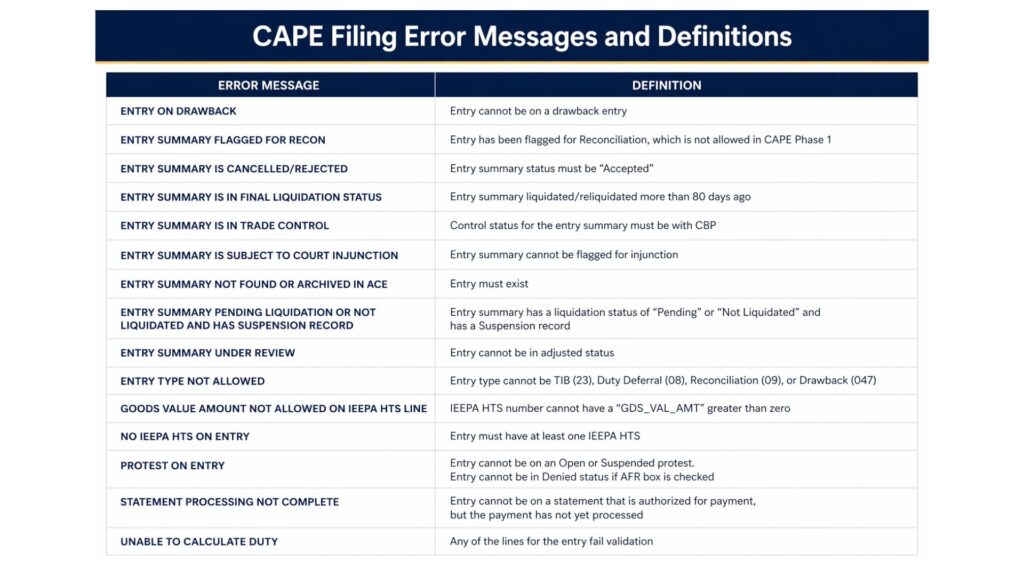
CBP officially launched the CAPE portal on April 20, introducing a new process for requesting refunds tied to IEEPA duties through the ACE Portal. Instead of handling refunds one entry at a time, CBP is now consolidating them, recalculating duties automatically, and issuing payments in batches. While the process is designed to be more efficient, it also brings stricter validation rules and puts more pressure on getting the data right before submission.
All refund requests must now be submitted through CAPE using a CSV file that includes entry numbers only. Once filed, CBP validates each entry, removes the IEEPA duties, recalculates the totals, and moves the entries through liquidation or reliquidation. Refunds are issued as a single consolidated payment rather than per entry, and in most cases, are expected within 60 to 90 days after the CAPE Declaration is accepted, assuming there are no issues that require additional review.
As filings begin, one of the biggest challenges has been validation errors. These are not system issues, but data or eligibility problems tied to the entry itself. If an entry does not meet CAPE requirements, it will be removed from the submission while the remaining entries continue processing. This makes it important to review entries carefully before filing, since small issues can delay part of a refund without stopping the entire request.
CBP also introduced a new report in ACE called the REV-615 CAPE refund report in ACE. This report allows importers and brokers to connect CAPE claim numbers to the actual refund payments and the entries included in those refunds. Because payments are now issued in consolidated amounts, this added visibility helps with reconciliation and confirms that everything submitted was processed correctly. It also means every refund is traceable and can be reviewed later, which is important for audit visibility.
Overall, CAPE is not just a new filing tool. It is a more structured system with built-in validation and tracking. Taking the time to review entry data before submitting will help avoid delays, and the new reporting capabilities in ACE provide a clearer view of how refunds move from submission to payment.
Click Here to view the CBP FAQ Page
North American Transborder Freight Shows Shift Toward Mexico in February
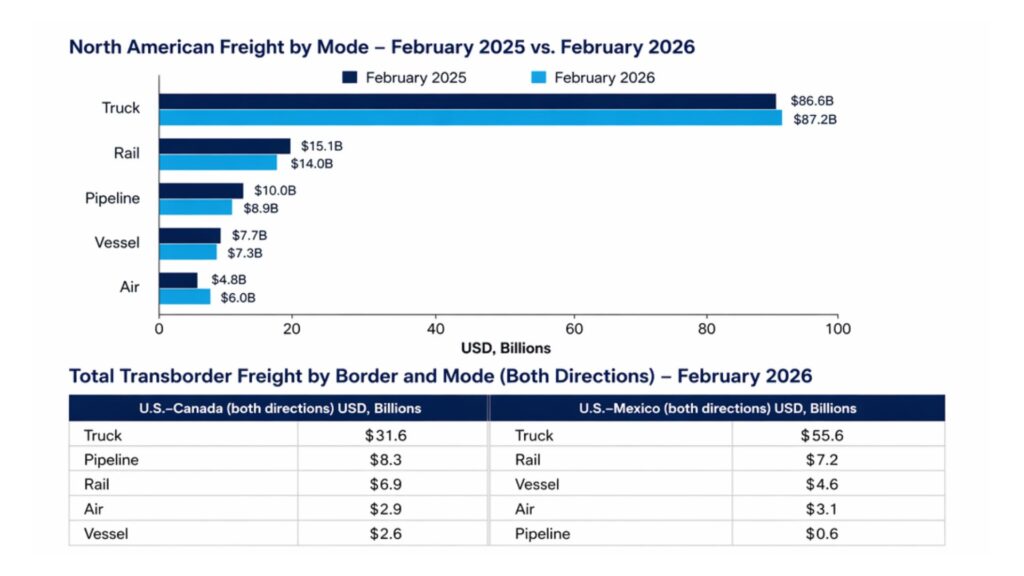
North American transborder freight totaled $130.8 billion in February 2026, a slight decrease of 0.7% compared to February 2025. While the overall change was minimal, the data shows a shift in trade patterns between U.S. partners. Freight between the U.S. and Canada declined 9.0% to $57.5 billion, while freight between the U.S. and Mexico increased 7.1% to $73.2 billion. This continues the trend of stronger activity along the southern border as supply chains adjust and manufacturing demand remains steady in Mexico.
Truck freight continues to dominate cross-border movement, carrying $87.2 billion in goods and increasing slightly year over year. Air cargo saw the largest growth, rising 25.2%, reflecting increased demand for higher-value and time-sensitive shipments. In contrast, rail, pipeline, and vessel movements all declined, with pipeline volumes down 10.2% and rail down 7.3%. These shifts suggest continued pressure on energy-related freight and bulk commodities, while more flexible and faster modes are gaining share.
At the port level, Laredo remains the top gateway for North American trade, followed by Detroit and other major crossings along both borders. Key commodities moving across the region include computer-related machinery, vehicles, electrical equipment, and energy products. Overall, the data highlights a steady but evolving trade environment, with stronger growth tied to U.S.-Mexico flows and slower activity on northern routes.
Looking ahead, these trends point to continued importance of cross-border planning and flexibility. Shippers may need to adjust routing strategies, monitor capacity at key ports, and stay aware of shifting demand between Canada and Mexico. As trade patterns continue to evolve, having visibility into mode selection, transit times, and border activity will be critical for maintaining efficiency and avoiding delays.
What It Really Takes to Keep Freight Moving When It Gets Difficult

Most of what keeps freight moving smoothly never gets seen.
On the surface, it looks simple. Containers arrive, appointments are scheduled, and freight gets delivered. But behind the scenes, especially when timelines are tight and facilities are constrained, there are constant adjustments being made to keep everything from falling behind.
Recently, we stepped in to support a client whose warehouse was at fully capacity and could no longer accept inbound freight. In just a few days, we moved 16 containers to our 3PL to assist with the overflow and mitigate detention that was otherwise accruing. This wasn’t a routine move. It required coordination, communication, and the ability to stay ahead of potential issues before they turned into real problems.
Through proactive scheduling and hands-on management, we were able to keep everything moving without disruption. Every appointment was monitored, every change was addressed in real time, and every container was treated as part of a larger plan. As of now, we’re on track to keep total carrier detention across all 16 containers to under five days combined.
That kind of outcome doesn’t happen by accident. It comes from staying involved, understanding the operation, and making decisions that protect the bigger picture. It also comes from treating every shipment like it matters, because it does.
Anyone can move freight when everything is running smoothly.
The real test comes when things get tight. When capacity is limited. When schedules shift. When there’s no room for error. That’s where the difference between booking freight and managing it becomes clear.
The lowest rate on paper can look like the right choice upfront. But when service breaks down, the real cost adds up quickly. Delays, missed appointments, detention, and lost time can easily outweigh any initial savings. What looks cheaper at the start often costs more later.
With many contracts still open in today’s market, it’s worth taking a closer look at who you’re working with. Not just what they charge, but how they perform when it matters most.
Are you working with a provider, or a team that will step in, solve problems, and have your back when things get difficult?
If you’re looking for a team that stays ahead, communicates clearly, and treats your business like their own, we’re here and ready when you are. ➡️ Call us at 833-782-7628 Ext. 1 or click here to schedule a quick call.
Supreme Court Reviews Broker Liability in Trucking Case

A case now before the U.S. Supreme Court, Montgomery v. Caribe Transport II, LLC, could shape how responsibility is handled in serious truck accident claims. The core issue is whether freight brokers can be held liable for how they select motor carriers, or if federal transportation law limits those types of claims. Courts across the country have ruled differently on this, creating uncertainty for brokers, shippers, and insurers.
Those supporting liability argue that brokers play a key role in choosing carriers and should be accountable if unsafe companies are hired, especially in cases involving carriers with poor safety histories or “chameleon carriers” that restart under new names. Others, including the federal government, argue that brokers do not operate trucks and should not be treated the same as motor carriers, warning that expanded liability could disrupt how freight moves and increase costs.
The Court’s decision could impact how carriers are selected, how risk is managed, and how contracts are structured moving forward. Regardless of the outcome, the case highlights the continued focus on safety, due diligence, and documentation across the transportation industry. Click here to view the oral argument transcript.