

Global Shipping and Trade Update March 2026 | Tariffs, Surcharges and FMCSA Changes

New IEEPA Court Order Expands Refund Coverage and the Clock Is Ticking
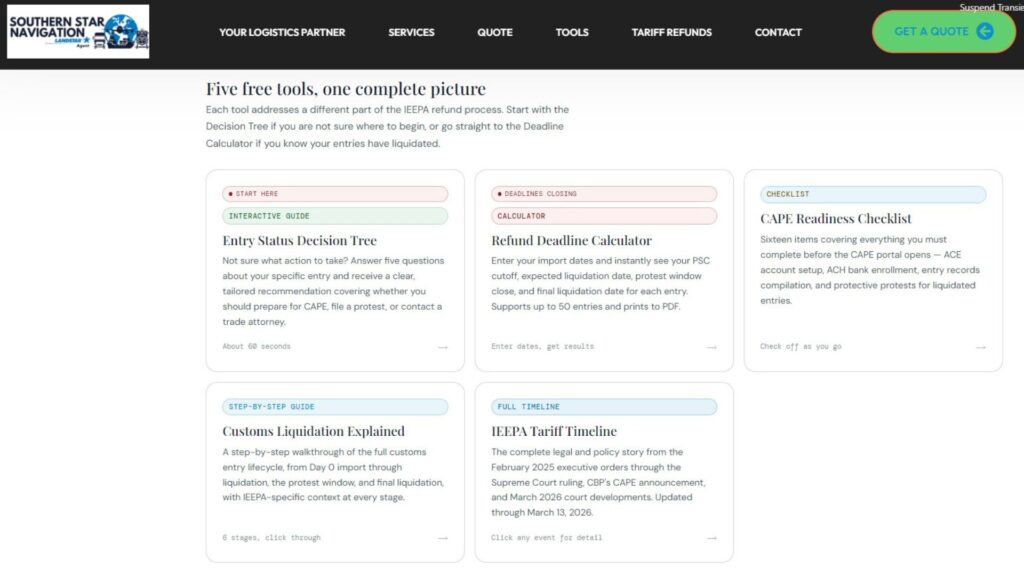
On March 20, 2026, the Court of International Trade expanded the IEEPA tariff refund process to include duties paid on imports from Brazil and India and confirmed CBP is on track with its mid-April 2026 launch of CAPE, the new ACE portal system that will allow importers to upload eligible entries and receive electronic duty refunds with interest. CBP must file its next progress report by March 31, 2026 with a settlement conference the same day, so more updates are coming soon. This is the largest tariff refund event in U.S. history with an estimated tens of billions in duties paid across more than 330,000 importers and the process is moving quickly.
The most important thing your business can do right now is confirm your ACE account is properly set up with ACH electronic banking details enrolled. As of February 6, 2026, CBP no longer issues paper checks and if your account is not configured when CAPE opens, your refund goes to reject status. Fewer than 10% of potentially eligible importers have completed this setup. Eligibility also depends on your entry status, so not every import during the IEEPA period will qualify and the refund amount will vary based on what IEEPA duties your company actually paid on eligible entries. If your entries have finally liquidated, a separate protest process applies with strict 180-day deadlines that are different for every shipment.
Southern Star Navigation has built a free IEEPA Tariff Refund Resource Center at southernstarnavigation.com with tools to help you check your eligibility, calculate your deadlines, and make sure you are ready before the portal opens. Our resource center includes an Entry Status Decision Tree, a Refund Deadline Calculator, a CAPE Readiness Checklist, a Customs Liquidation Guide, and a full interactive IEEPA Tariff Timeline updated through this week’s latest court order. Visit our IEEPA Refund page for all the details.
FMC Pushes Back on Immediate Middle East Surcharges

Ocean carriers are moving to recover rising costs tied to the Middle East conflict, but those charges are not hitting just yet. Several major carriers filed for new surcharges earlier this month and asked to apply them immediately, but the Federal Maritime Commission rejected those requests and kept the standard 30-day notice period in place. That means these fees cannot take effect right away and are now expected to begin in early April at the earliest. The push for faster implementation was tied to higher fuel costs, vessel rerouting, insurance increases, and overall disruption across the region.
For shippers, this creates a short window to prepare before these added costs begin showing up on invoices. The charges are still coming, but the delay gives time to review contracts, budgets, and exposure across affected trade lanes. It also reinforces that carriers must follow proper notice rules and support any new surcharges with clear reasoning. As we move closer to April, we expect these fees to start rolling out, so now is the time to stay alert and plan ahead.
FMCSA Rule Changes Now Live, Cutting Outdated Requirements for Carriers

Several FMCSA rule changes officially took effect on March 23, and most of them are designed to simplify compliance rather than add new requirements. These updates come from a broader effort to remove outdated rules that no longer match how the industry operates today. Electronic driver vehicle inspection reports are now clearly allowed in the regulations, removing any gray area for carriers using digital systems. At the same time, the long-standing 95% fuel tank limit has been eliminated, recognizing that modern fuel systems and designs make the old restriction unnecessary.
Other changes focus on reducing unnecessary maintenance and equipment violations. Rear-impact guard labels are no longer required as long as the equipment itself is structurally sound, and tractors do not need a working license plate light while pulling a trailer if the plate is not visible. The FMCSA also removed liquid-burning flares as an approved emergency device, meaning fleets must use compliant alternatives like reflective triangles. Overall, these updates are meant to reduce “gotcha” violations and make day-to-day compliance more practical, but it is still important to review internal procedures to stay aligned with the new rules.
WTO Reform Back in Focus: What the Latest U.S. Update Means for Global Trade

This week, the United States released a new report ahead of the World Trade Organization’s Ministerial Conference, continuing its push for reform. While this is not a new rule or regulation, it does give a clear look at how trade policy is evolving. The U.S. is raising concerns that the current system is outdated and no longer reflects how global trade actually works today. Key areas of focus include transparency, fair competition, and whether all countries should continue to receive the same trade benefits under existing rules like Most Favored Nation.
What matters most for businesses is the direction this points to. Trade is becoming less
“one-size-fits-all” and more focused on balance, reciprocity, and national interests. We are already seeing this through tariffs, supply chain shifts, and country-specific policies, and this report reinforces that those trends are here to stay. While there is no immediate change to shipments or compliance requirements, companies should expect continued shifts in how trade rules are applied and enforced moving forward.
Read the Full U.S. WTO Reform Report (March 2026)
Airfreight Rates Climb Again as Middle East Disruptions Continue

Airfreight rates are moving up again, and we’re starting to feel it across multiple trade lanes. The latest data shows global airfreight pricing jumped another 6.2% last week, now sitting slightly above where it was this time last year. A big driver behind this is fuel. Jet fuel prices have risen sharply, in some cases more than doubling over the past month and as expected, carriers are passing those costs along through fuel surcharges. On top of that, ongoing conflict in the Middle East is limiting available airspace, which is tightening capacity and pushing rates even higher.
We’re seeing the biggest increases coming out of Asia, especially from key hubs like Hong Kong, Shanghai, India, and South Korea. Some lanes are starting to look like peak season pricing again, even though we’re not there yet. Europe is also seeing steady increases across most major routes, including shipments moving into the U.S. North America is a bit more mixed right now, with some lanes rising while others soften slightly. Overall, the trend is clear. Less capacity and higher fuel costs are continuing to drive airfreight rates up, and this is something we’ll want to keep a close eye on in the coming weeks.
America First Trade Policy Expands in 2026

The Office of the United States Trade Representative has released the President’s 2026 Trade Policy Agenda along with the 2025 Annual Report, outlining the Administration’s priorities for the year ahead. The central message is clear: the focus remains on reshoring production, reducing trade deficits, strengthening supply chains tied to national security, and negotiating trade relationships based on reciprocity. The Administration states that 2025 marked measurable progress, including a reduction in the goods trade deficit and expanded export activity across several sectors.
One of the most significant initiatives moving forward is the continued expansion of the Agreement on Reciprocal Trade (ART) program. Under this structure, trading partners agree to substantially reduce tariffs and non-tariff barriers on U.S. exports, while the United States maintains modified tariff rates designed to rebalance trade flows. Several bilateral agreements were finalized in 2025, and additional framework deals are expected to be converted into binding agreements throughout 2026. For exporters, this may create new market access opportunities. For importers, it signals continued reliance on tariff leverage as a policy tool.
The agenda also emphasizes enforcement. Ongoing and potential Section 301 actions, continued Section 232 measures in critical industries, and closer monitoring of customs compliance are all highlighted as priorities. Critical minerals, semiconductors, pharmaceuticals, steel, aluminum, automotive products, and energy inputs remain sectors under heightened scrutiny. The Administration has also signaled a formal review of the U.S.–Mexico–Canada Agreement this year, which could introduce adjustments affecting North American trade flows, rules of origin, and compliance requirements.
Trade with China remains a focal point, with the Administration reiterating its intent to manage bilateral trade toward what it describes as fairness and balance. At the same time, the United States plans to pursue reform efforts in international trade institutions, including engagement at the WTO, G7, and G20. For businesses operating in global supply chains, the direction of U.S. trade policy suggests continued volatility in tariff application, stronger enforcement measures, and sustained attention to strategic manufacturing and sourcing decisions.
Understanding CBP’s UFLPA Dashboard and What It Means for Importers
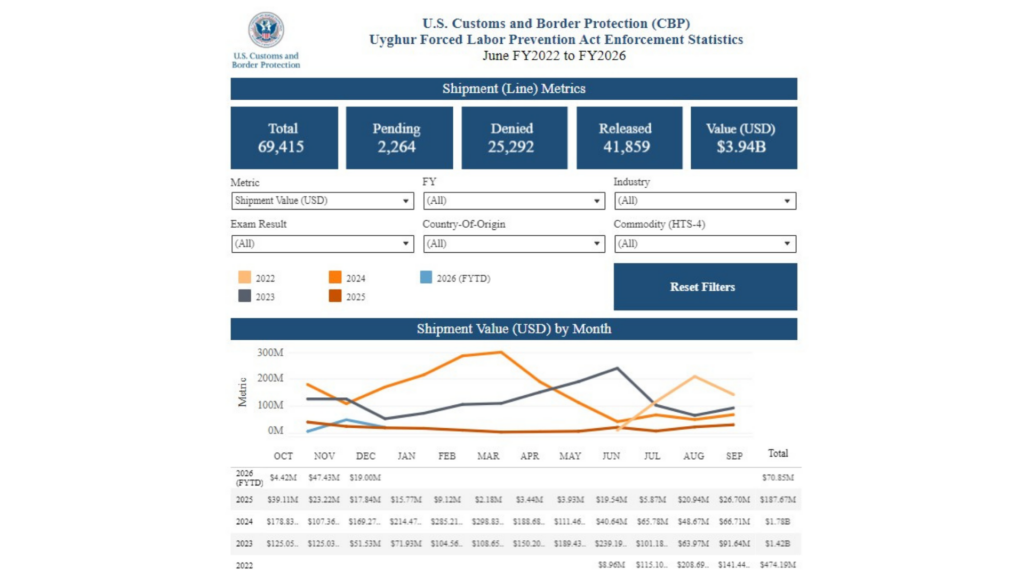
U.S. Customs and Border Protection continue to expand how it shares enforcement data under the Uyghur Forced Labor Prevention Act. The UFLPA Enforcement Statistics Dashboard provides shipment counts, cargo value, industries, countries of origin, ports of entry, and results by four-digit tariff headings. This level of transparency gives the trade community clearer insight into where enforcement activity is concentrated. One term that has drawn attention is stopped. CBP has explained that this status reflects shipments paused due to a potential risk indicator. It does not automatically mean the cargo has been formally detained or physically examined, and many shipments in this category are later released after review.
For importers, the dashboard should be viewed as an early warning tool rather than a simple pass or fail scorecard. Patterns by product category or sourcing region can signal where documentation, traceability, and supplier verification may need strengthening. Even when cargo is ultimately released, information requests can still create delays and added cost. Companies that monitor trends and prepare records in advance are in a stronger position than those responding under pressure. Using the data proactively can help reduce surprises and improve overall compliance readiness. Click here to review the dashboard.