Court Orders CBP to Correct IEEPA Tariff Entries and Opens Path for Refunds
To Our Valued Partners,
We want to share an important update regarding the ongoing litigation over the IEEPA tariffs.
On March 4, 2026, the U.S. Court of International Trade (CIT) issued an order directing U.S. Customs and Border Protection (CBP) to begin correcting certain entries that were subject to the IEEPA duties.
Based on the order, the court instructed CBP to take the following actions:
• Liquidate entries that have not yet liquidated without the IEEPA duties
• Reliquidate entries that already liquidated but are not yet final and remove the IEEPA duties
One important point is that entries that are already final were not addressed in this order.
The March 4 order focuses on entries that remain legally open under the customs framework. It does not yet establish a final nationwide refund process or determine how entries that are already final will ultimately be handled.
The court has scheduled a conference with the government tomorrow, March 6 to begin discussing how the remaining refund process may be handled. That discussion is expected to focus on entries that are already final and the broader mechanics of refunds. _________________________________
Why the Court May Be Moving Toward Nationwide Relief
One detail in the order is the language used by the judge when discussing duties.
The order references the constitutional requirement that duties must be uniform throughout the United States.
What this means is, tariffs cannot be applied differently to different importers depending on where they are located.
Because of that principle, the language in the order suggests the court may be leaning toward a nationwide remedy rather than limiting relief only to the plaintiffs involved in the case.
If the ruling ultimately applies nationwide, it could avoid thousands of separate lawsuits and allow CBP to apply a uniform correction process across affected entries.
How the Customs Liquidation Timeline Works
Understanding the customs liquidation process is important because the court’s order directly interacts with that timeline.
Customs Entry Liquidation Timeline
ENTRY FILED Importer files entry and deposits estimated duties.
↓
UP TO APPROXIMATELY 314 DAYS If CBP does not act, the entry typically liquidates automatically around 314 days after entry.
↓
CBP EXTENSION #1 CBP may extend liquidation for up to one additional year.
↓
CBP EXTENSION #2 CBP may extend liquidation again for another year.
↓
CBP EXTENSION #3 CBP may extend liquidation a third time for another year.
↓
MAXIMUM OPEN PERIOD An entry may remain unliquidated for up to approximately four years total.
↓
LIQUIDATION OCCURS
↓
180 DAY PROTEST WINDOW Importers generally have 180 days after liquidation to file a protest.
↓
FINAL LIQUIDATION If no protest is filed during that time, the liquidation becomes final and legally conclusive.
CBP Authority to Extend Liquidation
CBP has the authority to extend liquidation when additional review is needed.
Each extension can last up to one year, and CBP may issue up to three extensions.
Because of this authority, an entry may remain unliquidated for several years while CBP reviews classification, valuation, or other entry details.
In the context of the IEEPA ruling, CBP could potentially extend liquidation on certain entries while it reviews how the court’s order should be implemented or while it verifies entry data tied to the affected duties.
Liquidation vs Suspension of Liquidation
It is also helpful to understand the difference between liquidation and suspension of liquidation, since the two concepts are often confused.
Liquidation is the process where CBP finalizes the duties owed on an entry.
Suspension of liquidation occurs when the liquidation process is paused due to a legal action, investigation, or court order. While liquidation is suspended, the entry does not move forward toward finalization until the suspension is lifted.
The March 4 CIT order addresses liquidation and reliquidation of entries, rather than suspension.
Why This Timeline Matters for the IEEPA Case
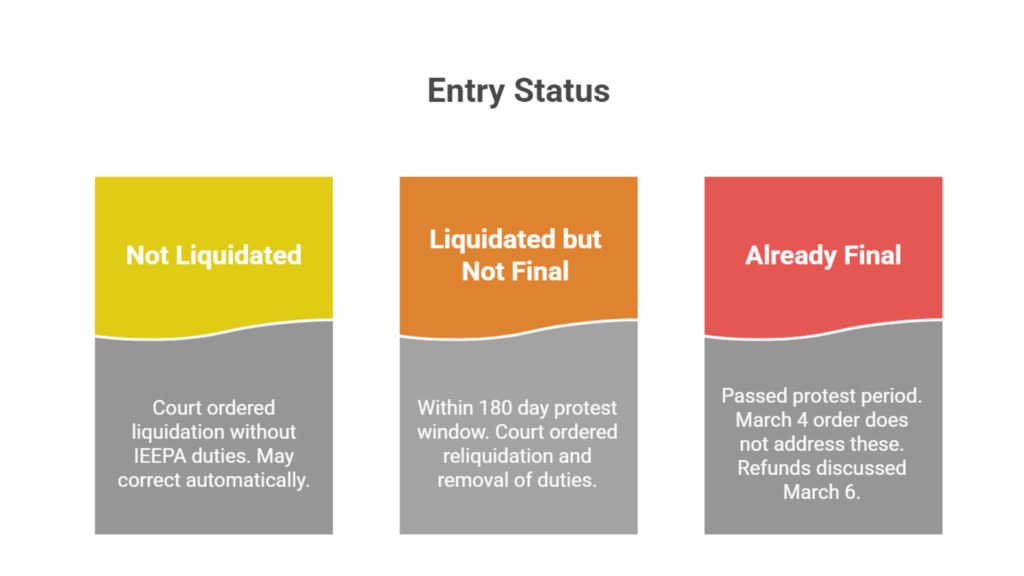
Because of how liquidation works, entries currently fall into several categories.
Category 1 Entries that have not liquidated yet
The court ordered CBP to liquidate these entries without the IEEPA duties.
These entries may correct automatically during liquidation.
Category 2 Entries that liquidated but are not yet final
These entries remain within the 180-day protest window.
The court ordered CBP to reliquidate these entries and remove the IEEPA duties.
Category 3 Entries that are already final
These entries have passed the protest period.
The March 4 order does not address these entries.
How refunds may apply to these entries will likely be discussed during the March 6 court conference.
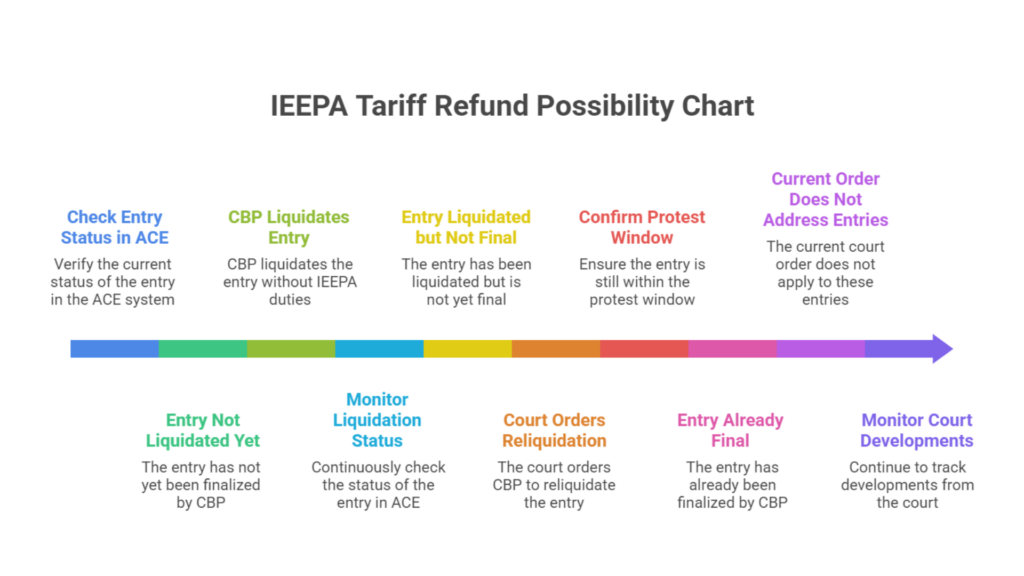
START Check the status of your entry in ACE.
↓
ENTRY HAS NOT LIQUIDATED YET
Result CBP has been ordered to liquidate the entry without the IEEPA duties.
Possible outcome Duty correction may occur automatically during liquidation.
Action Monitor liquidation status in ACE.
↓
ENTRY LIQUIDATED BUT NOT FINAL
Result The court ordered CBP to reliquidate the entry without the IEEPA duties.
Possible outcome Refunds may occur through the reliquidation process.
Action Confirm whether the entry remains within the protest window.
↓
ENTRY ALREADY FINAL
Result The current order does not address these entries.
Possible outcome Treatment of these entries will likely be discussed in the next phase of the case.
Action Continue monitoring developments from the court.
What Companies Should Be Checking Right Now in ACE
The most practical step importers can take right now is reviewing their entry status in ACE.
The key question is simple:
Has the entry liquidated yet and if so, is it final?
This will determine whether the court order may correct the entry automatically.
Shows • Entry number • Entry date • Liquidation status • Liquidation date • Duty lines and duty amounts
Entry Summary Liquidation Report
Shows • Entries that have liquidated • Entries that remain unliquidated • Liquidation dates
These reports allow importers to quickly identify which entries fall into the categories described above. ____________________________________________________
Practical Steps Companies May Want to Take Now
• Run ACE reports to identify entries that remain unliquidated
• Identify entries that liquidated but remain within the protest period
• Review duty lines tied to IEEPA tariff provisions
• Track entries that may already be final
• Organize entry data so it can be reviewed quickly if CBP issues refund guidance
Exporting ACE report data into Excel and sorting by entry date, liquidation date, and status can make this process easier.
Companies should also remember that any duty corrections will still be subject to normal customs review procedures, including potential verification of classification, valuation, and other entry data.
Important Bond Consideration
Importers should also keep customs bonds in mind during this process.
As long as entries remain unliquidated, the duty deposits tied to those entries may continue to count toward bond sufficiency calculations.
In some situations this may:
• Increase bond exposure
• Trigger higher bond requirements
• Prompt additional review from sureties
Reviewing entry status early can help companies understand potential bond implications while the refund process develops.
What Happens Next
The Court of International Trade will meet with the government tomorrow March 6 to begin discussing how the remaining refund process may be implemented.
That discussion is expected to focus primarily on entries that are already final and the broader mechanics of refunds.
We are actively monitoring official guidance and will share updates as new information becomes available. If you have questions, call me anytime at 833-782-7628 Ext. 1.