

CBP Request Readiness Checklist: What Importers Should Organize Before Questions Arise
When U.S. Customs and Border Protection asks a question about an entry, the challenge is not always whether the information exists. The bigger issue may be whether the importer knows where the records are, who has access to them, and who is responsible for coordinating the response.
That is why Southern Star Navigation created this CBP Request Readiness Checklist. It gives importers a practical way to review their entry documents, product information, customs broker communication, and Importer of Record visibility before questions arise.
The goal is not to create unnecessary concern. It is to help importers improve organization and understand what information may be important when goods are entering the United States.
What Are CBP Form 28 and CBP Form 29?
A CBP Form 28 is a Request for Information. CBP may use it when additional facts, records, or explanations are needed to review an import entry.
A CBP Form 29 is a Notice of Action. It may communicate an action CBP is proposing or has taken regarding an entry.
The facts and circumstances of every entry are different. An importer receiving either form should read the complete notice carefully, pay attention to the instructions and deadlines shown, and coordinate with the appropriate licensed customs broker, customs counsel, or qualified customs advisor.
The best time to determine where important records are stored is before a request arrives.
Why Import Documentation Readiness Matters
International shipments can involve several parties, including the importer, overseas supplier, manufacturer, freight forwarder, carrier, customs broker, warehouse, and delivery provider.
Each party may hold a different part of the shipment file.
The supplier may have product specifications and manufacturing records. The broker may have entry documents and filing details. The importer may have purchase orders, payment records, contracts, and internal product information. The freight provider may have transportation records and shipment documents.
When these records are scattered across different companies, inboxes, systems, or employees, even a straightforward question can take longer to address.
CBP request readiness starts with visibility. Importers should know:
- What information was used to prepare the entry
- Who supplied that information
- Who reviewed the filing details
- Where the supporting records are stored
- Who should be contacted first if questions arise
A customs broker can assist with the filing process, but the importer should still understand its own products, transactions, and import arrangements.
1. Review the Entry and Shipment Documents
The first section of the CBP Request Readiness Checklist focuses on the basic entry and transportation file.
Importers may want to confirm that they can locate:
- Commercial invoices
- Packing lists
- Bills of lading
- Arrival records
- Entry summaries
- Customs broker file copies
- Duty, tariff, and fee support
These records should tell a consistent story.
Product descriptions, quantities, values, purchase terms, shipment details, and parties to the transaction should not conflict across the documents. Differences are not automatically improper, but the importer should understand why they exist and whether additional explanation may be needed.
A useful internal test is simple: could the company locate the complete entry file without searching through several unrelated systems or waiting for multiple outside parties?
2. Organize HTS Classification Support
HTS classification affects duty rates, tariff measures, reporting requirements, and other import obligations. It should not be based only on a short product name appearing on a commercial invoice.
Classification support may include:
- The HTS code used on the entry
- A detailed product description
- The product’s intended use
- Material or component information
- Technical specifications
- Photographs or diagrams
- Prior classification research
- Applicable CBP rulings, when available
Descriptions such as “parts,” “accessories,” “samples,” or “equipment” may not provide enough information by themselves. The importer and customs broker may need details about what the product is made from, how it functions, how it is sold, and what role it performs.
Product information should also remain consistent from one shipment to the next. When a supplier changes a material, component, design, or intended use, the importer may need to review whether the existing classification still fits the product.
3. Keep Customs Valuation Support Available
Customs valuation is another important area of import documentation readiness.
The commercial invoice price may be a starting point, but importers may need additional records to explain how the entered value was determined.
Relevant information may include:
- Purchase orders
- Supplier invoices
- Payment records
- Pricing agreements
- Assists or additions
- Freight and insurance treatment
- Discounts
- Royalties or license fees
- Related-party transaction information
An assist may include certain materials, tools, molds, designs, or other items supplied by the buyer for use in producing imported merchandise. Whether a particular cost must be included depends on the facts of the transaction.
Importers should avoid waiting until questions arise to determine how prices, discounts, additions, or related-party arrangements were handled.
4. Review Country of Origin and Tariff Exposure
Country of origin is not always determined simply by where the goods were shipped from. The analysis may depend on where the merchandise was manufactured, produced, assembled, or substantially transformed.
Importers may want to maintain:
- Manufacturer information
- Supplier statements
- Production details
- Component sourcing information
- Country-of-origin support
- Marking information
- Special tariff program documentation
The entry should also be reviewed for possible exposure to measures such as Section 232 or Section 301 duties, as well as antidumping or countervailing duty requirements.
When special duty treatment is claimed, the supporting records may become especially important. This can include Chapter 98 provisions, free trade agreement claims, returned goods, repaired merchandise, prototypes, or other special tariff programs.
A claim should be supported by the facts and documents required for that specific program.
5. Confirm Broker and Importer of Record Visibility
A common operational problem is not knowing who controls the customs process.
The importer should be able to answer:
- Who is acting as the Importer of Record?
- Who filed the entry?
- Which customs broker handled the transaction?
- Who provided the product description and HTS code?
- Who approved the declared value and country of origin?
- Who receives CBP messages or notices?
- Can the importer obtain the entry records quickly?
This can be particularly important with DDP or supplier-controlled shipping arrangements. A seller or overseas party may coordinate transportation and customs clearance, but the buyer should still understand the filing structure and know which company is listed as the Importer of Record.
Convenience should not eliminate visibility.
6. Ask the Right Questions Before Cargo Moves
Many import problems begin before the shipment leaves the supplier.
Before cargo moves, importers may want to ask:
- Are the product descriptions complete and consistent?
- Has the correct product information been provided to the broker?
- Does the buyer understand the Importer of Record setup?
- Are value, origin, and classification support available?
- Are special tariff claims clearly documented?
- Is responsibility clear if CBP asks questions?
- Is there a plan for locating records quickly?
These questions do not guarantee that an entry will never be reviewed. They can, however, make the process more organized and help the importer communicate more effectively with its customs and logistics partners.
Take the Two-Minute Readiness Test
The checklist includes four simple questions:
- Could we locate the full entry file quickly?
- Do we know who would respond first if CBP asks questions?
- Can we support classification, value, and origin?
- Do we have visibility before cargo moves?
If any answer is no, the process may be worth reviewing now.
The purpose of this exercise is not to assign blame. It is to identify practical gaps before they become urgent.
How Southern Star Navigation Can Help
Southern Star Navigation supports international ocean, air, truck, rail, and cross-border freight movement.
Our role may include helping customers improve shipment visibility, coordinate with customs brokerage resources, identify missing transportation documents, and strengthen communication before cargo moves.
We do not replace the importer’s licensed customs broker, customs counsel, or internal trade compliance team. Instead, we help connect the transportation and documentation sides of the shipment so that the appropriate parties have better visibility.
Clear communication among the importer, supplier, broker, and logistics provider can make an international shipment easier to manage from origin through final delivery.
Download the CBP Request Readiness Checklist
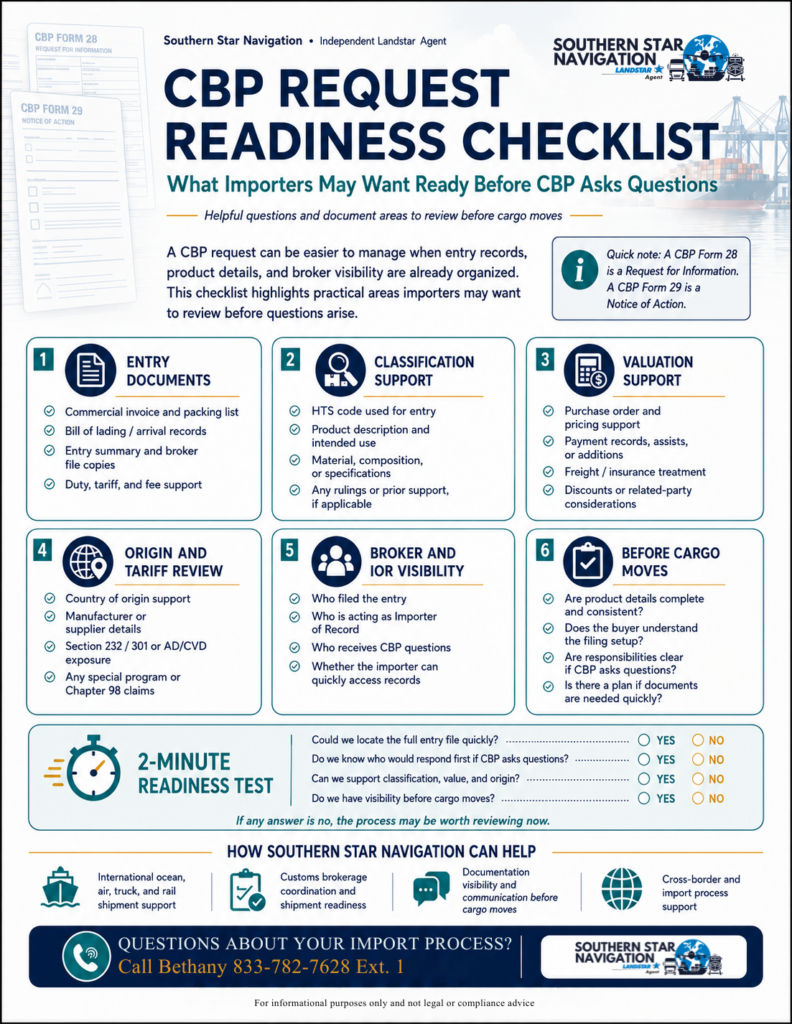
The CBP Request Readiness Checklist is designed to be a practical starting point for importers reviewing their customs documentation and import process.
Use it with your internal team, purchasing department, customs broker, overseas supplier, or logistics provider to discuss:
- Entry document organization
- HTS classification support
- Customs valuation records
- Country-of-origin documentation
- Tariff and special program exposure
- Broker and Importer of Record visibility
- Questions to address before cargo moves
Being ready does not mean having every possible answer in advance. It means knowing where the information is, who is responsible for it, and how the right people will communicate if questions arise.
For questions about international shipping, customs brokerage coordination, or shipment readiness, contact Bethany at 833-782-7628 Ext. 1.
This article and checklist are provided for general informational purposes only and are not legal or compliance advice. Importers should consult a licensed customs broker, customs counsel, or another qualified advisor regarding specific transactions or CBP notices.