
July 2026 Freight and Trade Updates

Ocean Freight Rates Rise as U.S. Import Demand Builds
U.S. container imports moved higher heading into July as importers brought more cargo into the country. June containerized imports reached approximately 2.40 million TEUs, up 8.2% from June 2025, although volume was slightly lower than May. Imports from China were especially strong, rising 27.4% year over year. Even with the June increase, total U.S. imports for the first half of 2026 were down only 0.3% from the same period last year.
The stronger demand is putting upward pressure on transpacific ocean rates. Rates from the Far East to the U.S. West Coast increased 7% during the week ending June 28 and were 91% higher than a year earlier. Some importers appear to be moving shipments earlier than planned ahead of possible tariff increases later this year. Peak season surcharges have also started on some eastbound transpacific services, adding another layer of cost for cargo moving from Asia to the United States.
West Coast ports remain an important part of the current increase. The number of containerships heading toward Los Angeles and Long Beach was up by a high-single-digit percentage compared with last year. Weekly import activity at the two ports remains elevated, while East and Gulf Coast ports have also recently gained some share of U.S. container imports. Importers should continue booking early, checking space before cargo is ready and allowing enough time for port, rail, and inland delivery coordination.
The ocean logistics industry is also continuing to expand beyond traditional port-to-port transportation. CMA CGM has agreed to purchase FedEx Supply Chain for $1.4 billion. The deal is expected to close later in 2026, subject to regulatory approval and other closing conditions. It is another sign that major ocean carriers are investing in warehousing, fulfillment, and inland logistics as customers look for better visibility and fewer handoffs across their supply chains.

CBP Updates Customs Interest Rates for the New Quarter
U.S. Customs and Border Protection published the updated quarterly interest rates used to calculate interest on overdue customs accounts and refunds of customs duties. For the calendar quarter beginning July 1, 2026, the underpayment rate is 7% for both corporations and non-corporations. The overpayment rate is 7% for non-corporations and 6% for corporations.
This matters because interest may apply when duties are paid late and when customs duties are refunded. Importers should review liquidation dates, duty payments, refund calculations, protest deadlines, and any interest that may apply, especially when a refund, reliquidation, protest, or other post-entry action is still pending. View the Federal Register notice.
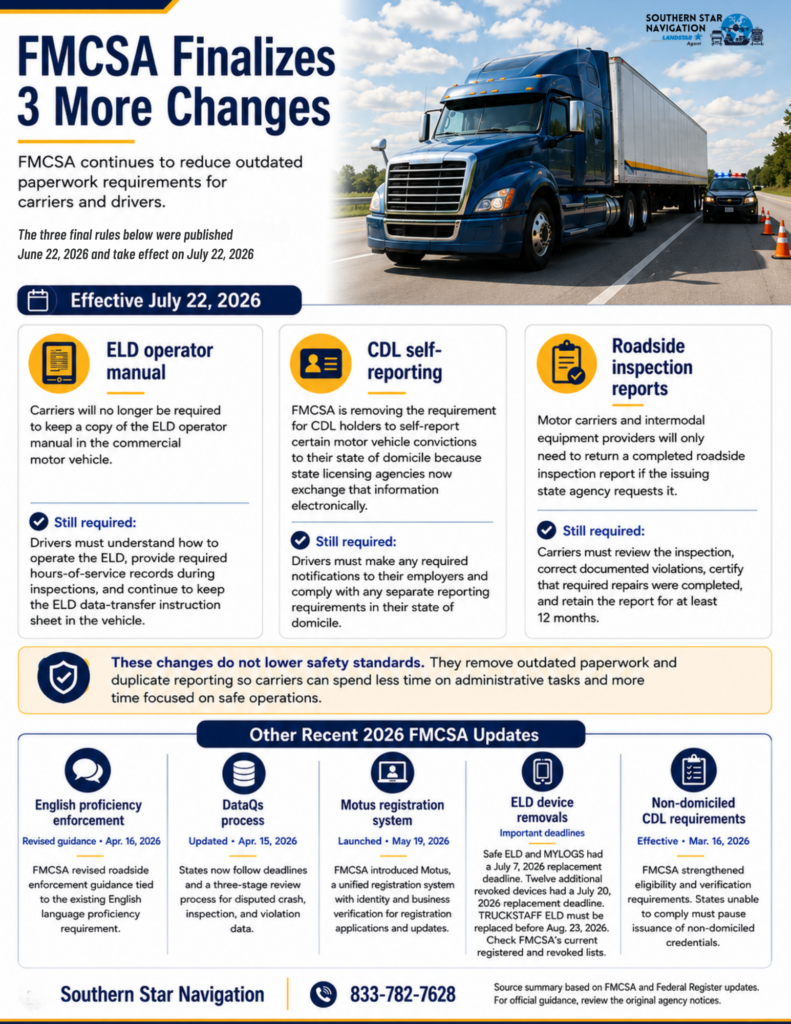
FMCSA Finalizes Three Compliance Changes Effective July 22
The Federal Motor Carrier Safety Administration has finalized three separate rule changes intended to remove outdated paperwork and duplicate reporting requirements for commercial drivers and motor carriers. All three were published on June 22 and take effect July 22, 2026.
First, carriers will no longer be required to keep a copy of the electronic logging device operator’s manual inside the commercial motor vehicle. Drivers must still understand how to operate the ELD, maintain accurate hours-of-service records, and provide required information during an inspection. Carriers must also continue providing the separate instruction sheet that explains how ELD records are produced and transferred to an authorized safety official.
Second, the federal requirement for CDL holders to report certain motor vehicle convictions to the licensing agency in their state of domicile is being removed because state agencies now exchange that information electronically. Drivers must still make any required notifications to their employers and comply with any separate reporting rules in their state of domicile.
The third change affects completed roadside inspection reports. Beginning July 22, motor carriers and intermodal equipment providers will only have to sign and return a completed inspection report when the issuing state agency requests it. They must still review the inspection, correct documented violations, certify that required repairs were completed, and retain the report as required.
Together, the three final rules reduce administrative work without changing the underlying ELD, driver qualification, hours-of-service, inspection, repair, or safety requirements. Carriers should review their written procedures before July 22 so employees understand which paperwork is being eliminated and which compliance duties remain in place.
USMCA Review Brings New Trade Uncertainty

USTR issued a statement on July 1 following the required USMCA joint review between the United States, Mexico, and Canada. The United States did not agree to renew the agreement in its current form. However, the USMCA remains in effect while the countries continue working through the outstanding issues or until the agreement is terminated.
For now, this does not end the agreement or stop companies from making valid USMCA claims. Importers, exporters, and cross-border shippers should continue following current procedures while watching for further updates. Companies that rely on North American sourcing, origin certifications, supplier records, or USMCA duty treatment should pay especially close attention. The United States is expected to meet with Mexico during the week of July 20 for another round of negotiations.
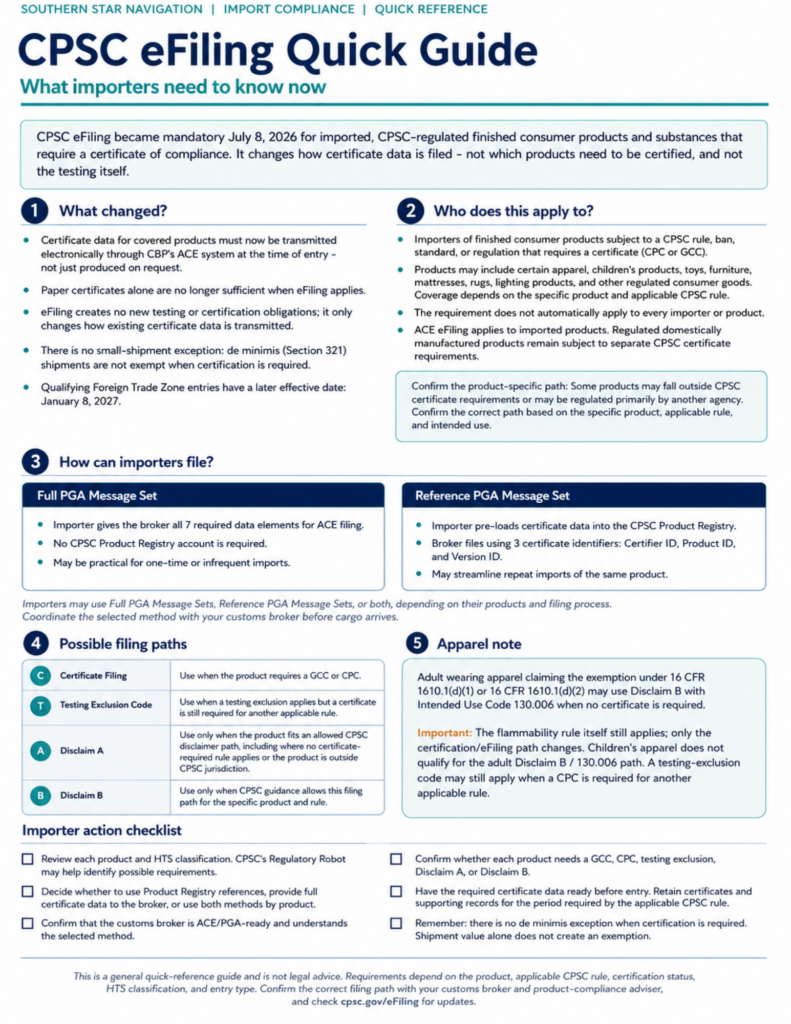
CPSC eFiling Requirements Are Now in Effect
New CPSC eFiling requirements took effect on July 8, 2026. They do not apply to every importer or every product. The requirements apply to imported, CPSC-regulated finished consumer products and substances that are required to be certified. For covered products, certificate information must now be transmitted electronically through CBP’s ACE system. Importers can provide the complete certificate data to their customs broker through a Full PGA Message Set or store the certificate in the CPSC Product Registry and provide the broker with the identifiers needed for a Reference PGA Message Set.
Importers should review each product and its HTS classification with their customs broker or compliance adviser to determine whether the product requires a General Certificate of Conformity, a Children’s Product Certificate, testing-exclusion information, or whether an optional Disclaim A or Disclaim B filing is appropriate. For example, CPSC guidance says qualifying adult wearing apparel claiming an exemption under 16 CFR 1610.1(d)(1) or (2) may use Disclaim B with Intended Use Code 130.006 when no certificate is required. Confirming the correct filing process before cargo arrives can help prevent last-minute documentation issues, entry questions, and unnecessary delays.
EU Implements U.S. Trade Deal Tariff Changes

The EU has started implementing its side of the U.S.-EU trade framework. Regulation 2026/1455 began applying on July 1, 2026, and changes the duty treatment for certain U.S.-origin goods listed in the regulation. It also establishes tariff-rate quotas for certain U.S. agricultural and seafood products.
For companies exporting U.S.-origin goods into the EU, the reduced duty treatment is not automatic across every shipment. Importers should confirm the EU CN classification, verify that the product is covered by the applicable annex, and make sure the origin documentation supports the claim. Until dedicated preferential origin rules are adopted, companies may need to rely on EU non-preferential origin standards, including whether the goods are wholly obtained in the United States or substantially transformed there.
Companies shipping U.S.-origin goods to the EU should review the details before the cargo moves. Classification, origin support, paperwork, and broker instructions can all affect whether reduced duty treatment or a tariff-rate quota may be used. Southern Star Navigation can help coordinate the freight process and communication between the parties involved so there are fewer surprises along the way.

Cargo can be damaged, lost, or stolen while moving by ocean, air, rail, or truck. Carrier liability may be limited and may not cover the full value of the goods.
Marine cargo insurance can provide added financial protection for shipments in transit. Coverage depends on the policy terms, cargo value, commodity, packaging, route, and selected limits.
Marine cargo insurance may help protect against certain covered losses, including:
- Theft or missing cargo
- Fire or collision
- Severe weather
- Accidental damage during transit
- Other covered risks listed in the policy
Coverage is not automatic. Exclusions, deductibles, valuation rules, and special conditions may apply. Shippers should confirm that the cargo description, insured value, origin, destination, and route are correct before the shipment moves.
For more information, call Southern Star Navigation at 833-782-7628 Ext. 1
or email: starsales@southernstarnav.com