

We Share the Road: Simple Semi Truck Safety Reminders for Holiday Travel
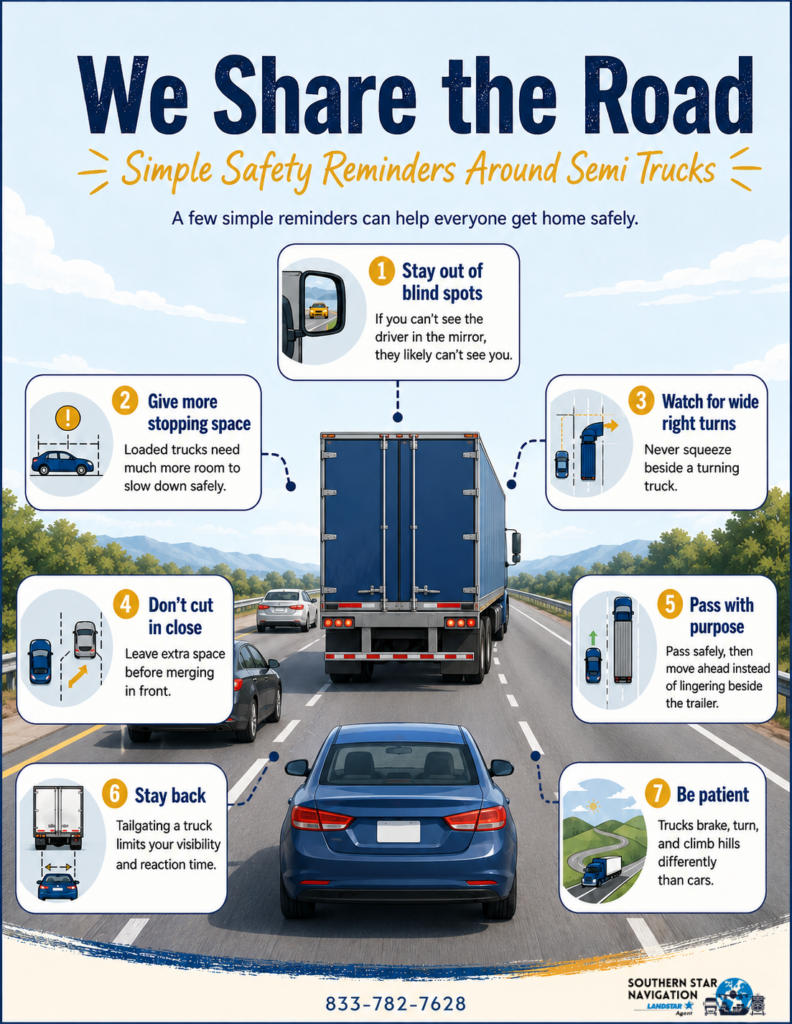
With Fourth of July travel and summer road trips picking up, it is a good time for a simple reminder: we all share the road.
Every day, semi trucks, tractor trailers, delivery trucks, and commercial vehicles help move the freight that keeps businesses, families, stores, hospitals, and communities running. These trucks carry the products people use every day, from food and household goods to retail inventory, construction materials, medical supplies, and imported cargo moving inland after it arrives in the United States.
Most people drive near semi trucks regularly, but many passenger vehicle drivers were never really taught how to safely share the road with them. A semi truck does not stop, turn, merge, accelerate, or climb hills the same way a car does. When drivers understand those differences, they can make better decisions on the road.
Semi truck safety is not about blame. It is about awareness. A little more space, patience, and visibility can help protect truck drivers, passenger vehicle drivers, families, motorcyclists, and everyone traveling on our highways.
Why Semi Truck Safety Matters
A fully loaded tractor trailer can weigh up to 80,000 pounds. That size and weight create different driving challenges than a passenger vehicle. Large trucks need more room to stop. They have bigger blind spots. They often need extra space to make wide right turns. They may accelerate more slowly when merging or climbing hills, and they may gain speed differently going downhill.
For a passenger vehicle driver, those differences can be easy to overlook. A car may be able to stop quickly, change lanes easily, or fit into a small space. A semi truck cannot always do the same. When a car cuts closely in front of a truck, lingers beside a trailer, or squeezes into the turning space of a truck, it can create a dangerous situation before anyone has time to react.
That is why simple road safety reminders matter. They are not complicated. They are not only for professional drivers. They are for everyone.
1. Stay Out of Blind Spots
One of the most important semi truck safety tips is to stay out of blind spots. Large trucks have blind spots on all sides, including directly in front, directly behind, and along both sides of the trailer.
A good rule to remember is this: if you cannot see the truck driver in the truck’s side mirror, the driver likely cannot see you.
Many drivers do not realize how long a trailer blind spot can be. Lingering beside a semi truck, especially on the right side, can make it harder for the driver to know you are there. If you need to pass, pass safely and keep moving until you are clearly ahead.
2. Give More Stopping Space
Semi trucks need more room to slow down safely. That is especially true when the truck is fully loaded, traffic is heavy, weather is bad, or the road is wet.
Cutting in closely in front of a semi truck reduces the space the driver needs to stop. Even if the truck driver reacts immediately, the truck may not be able to slow down as quickly as a car. Leaving extra space is one of the easiest ways to help prevent a dangerous situation.
During holiday travel, roads are often more crowded. Drivers may be distracted, tired, or rushing to get somewhere. Giving trucks more stopping space is a simple way to make the road safer for everyone.
3. Watch for Wide Right Turns
Semi trucks often need extra space to turn, especially when making a right turn. A truck may swing slightly left before turning right so the trailer can clear the curb, pole, sign, or corner.
This can confuse passenger vehicle drivers. A car may see the open space on the right side of the truck and think it is safe to pull forward. It is not.
Never squeeze beside a turning truck. If a truck has its turn signal on, give it room. Wait until the truck completes the turn before moving forward. A few seconds of patience can prevent a serious crash.
4. Do Not Cut in Close
Merging too closely in front of a semi truck is one of the most common unsafe habits on the road. Passenger vehicle drivers may think there is enough room because their own car would fit. But fitting into the space does not mean it is safe.
When merging in front of a semi truck, make sure you can see the full truck in your rearview mirror before moving over. Use your signal, leave extra space, and avoid sudden lane changes.
This is especially important near exits, construction zones, toll areas, and heavy traffic. Quick movements around large trucks can be hard for drivers to anticipate.
5. Pass With Purpose
Passing a semi truck is sometimes necessary, but it should be done with care. Do not linger beside the trailer. Move steadily past the truck, make sure there is plenty of room, and then return to the lane only when it is safe.
Avoid passing on the right whenever possible. The right side of a truck can have a larger blind spot, and trucks may need that side space for turns, lane positioning, or merging.
Passing with purpose does not mean speeding or driving aggressively. It simply means avoiding the blind spot and giving the truck driver room to see and react.
6. Stay Back
Following too closely behind a semi truck limits your visibility. If you are directly behind a trailer, you may not be able to see traffic slowing ahead, road debris, brake lights further up the road, or changes in traffic flow.
Tailgating a truck also reduces your reaction time. If traffic suddenly stops, you may not have enough room to brake safely.
Staying back gives you a better view of the road and gives the truck driver more room to operate safely. It also helps keep your vehicle out of the truck’s rear blind spot.
7. Be Patient
Patience is one of the most underrated road safety habits. Semi trucks may take longer to accelerate from a stop, merge onto a highway, climb a hill, or complete a turn. That does not mean the driver is not paying attention. It often means the truck is operating safely for its size, weight, road conditions, and cargo.
During busy travel weeks, patience becomes even more important. Everyone wants to get where they are going, but rushing around large trucks can create unnecessary risk.
Giving a truck a little more room is not just courteous. It is safer.
Safe Freight Movement Starts With Shared Responsibility
At Southern Star Navigation, we understand that freight movement depends on many people working together. From international shipping and customs coordination to inland transportation and final delivery, freight does not move without professional drivers, dispatchers, carriers, logistics teams, brokers, shippers, and receivers.
But road safety is bigger than the freight industry. It belongs to everyone who drives, rides, works, or travels near commercial vehicles.
This Fourth of July week and throughout the summer, take a moment to slow down, look around, and give semi trucks the room they need. Stay out of blind spots. Leave extra stopping distance. Watch for wide turns. Do not cut in close. Pass safely. Stay back. Be patient.
We all share the road, and small choices can help everyone get home safely.