
Before You Agree to DDP: What Importers Should Review
DDP, or Delivered Duty Paid, can look like one of the simplest options in an international sales contract. The seller appears to handle the freight, duties, taxes, customs clearance, and delivery, which can make the transaction feel easier for the buyer.
But simple does not always mean visible, controlled, or cost effective.
For importers, the real question is not only who is paying for transportation. It is who controls the import process, who is acting as Importer of Record, who is managing customs documentation, who communicates with the customs broker, and who is responsible if something changes before cargo moves or after the shipment arrives.
With customs enforcement moving toward more importer accountability and documentation visibility, DDP arrangements deserve a closer look.
What DDP Means in Practical Terms
Under DDP, the seller generally assumes responsibility for delivering the goods to the named destination, including import clearance and payment of duties, taxes, and customs related charges required to complete the delivery.
That can be useful in certain situations, especially when the buyer wants a landed cost and does not want to manage the shipment directly. However, DDP should not be accepted without understanding what is actually included, what may be excluded, and who is responsible if something goes wrong.
For example, a buyer may assume the DDP price includes every possible destination cost. In reality, items such as VAT or GST, unloading, storage, demurrage, detention, exam fees, or other destination charges may be treated differently depending on the contract and how the shipment is handled.
That is why the named place of destination, and any exclusions should be clearly stated before the shipment moves.
The terms should not be left to interpretation after the cargo is already in transit.
Why Importer of Record Clarity Matters
One of the most important questions in any DDP arrangement is simple:
Who is acting as the Importer of Record?
The Importer of Record, often referred to as the IOR, is the party tied to the import transaction and customs entry. If the IOR setup is unclear, the buyer may not have full visibility into how the goods are being entered, which customs broker is filing the entry, what documentation is being submitted, or who is responsible if CBP asks questions later.
This matters even more when a foreign party or supplier-controlled arrangement is involved.
If the seller, supplier, or a foreign party is controlling the import process, importers should understand whether a foreign IOR is being used, whether the shipment is moving as an informal or formal entry, and whether the party managing the process is prepared for a more enforcement focused environment.
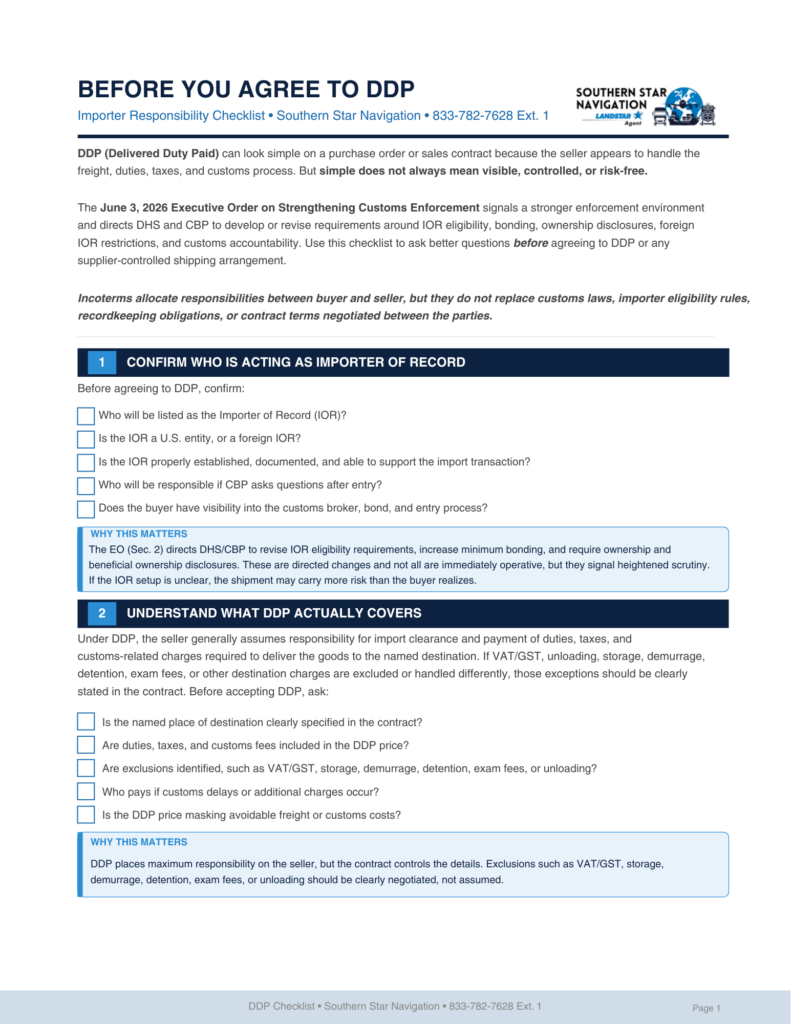
The June 3, 2026, Executive Order on Strengthening Customs Enforcement directs DHS and CBP to develop or revise requirements around IOR eligibility, bonding, ownership disclosures, foreign IOR restrictions, and customs accountability. Many of these items still require future implementation, but the direction is clear. Importer responsibility, documentation visibility, and customs process accountability are becoming more important.
DDP Can Limit Visibility
DDP can feel convenient because the seller appears to be handling everything. But that convenience can also reduce the buyer’s visibility.
Before agreeing to DDP, importers should ask:
Who will be listed as the Importer of Record?
Is the IOR a U.S. entity or a foreign IOR?
Who selects the customs broker?
Does the buyer know which broker is filing the entry?
Who receives the entry documents and shipment records?
Who responds if CBP requests additional information?
Are product descriptions, country of origin, valuation, and HTS classification being reviewed before cargo moves?
These questions may seem basic, but they can make a major difference when a shipment is delayed, examined, questioned, or assessed unexpected charges.
When the buyer lacks visibility, it can be harder to understand how the entry was filed, what information was provided, and who is accountable if a problem arises.
Documentation Should Be Reviewed Before Cargo Moves
Waiting until cargo is already moving can limit options.
Before shipment, importers should make sure the right parties have reviewed the commercial invoice, packing list, product descriptions, country of origin, valuation support, HTS classification, manufacturer or supplier details, and any required agency documentation.
Depending on the product and supply chain, additional information may also be relevant, including product identifiers, model or style numbers, composition, grade, size, specifications, forced labor risk indicators, sanctions exposure, or other supply chain records.
In a stricter enforcement environment, documentation gaps can become costly quickly. A missing detail, unclear product description, inaccurate valuation, origin concern, or communication breakdown between parties may create delays or added expenses that could have been addressed earlier.
This does not mean DDP is automatically the wrong choice. It means DDP should be reviewed carefully, especially when the buyer does not control the broker relationship or documentation flow.
Cost Certainty Is Not Always the Same as Cost Control
One reason companies choose DDP is because it appears to provide a complete delivered price.
That can be helpful, but importers should still ask what is actually included in the DDP price and what is excluded.
Are duties, taxes, and customs fees included?
Are VAT or GST obligations addressed clearly?
Who pays if customs delays occur?
Who pays for storage, demurrage, detention, exams, or unloading if those costs arise?
Is the DDP price masking avoidable freight or customs costs?
A DDP quote may look easy to accept, but that does not always mean it is the best option. In some cases, another Incoterm may provide better visibility, better control, or a clearer process for the buyer.
The goal is not to avoid DDP in every situation. The goal is to understand what the buyer may be giving up in exchange for convenience.
Questions Importers Should Ask Before Agreeing to DDP
Before signing a contract or accepting a DDP arrangement, importers should pause and ask a few practical questions:
Who is the Importer of Record?
Who is paying duties, taxes, and customs fees?
What charges are explicitly excluded from the DDP price?
Who is responsible for customs clearance and certifications?
Who selects and communicates with the customs broker?
Who verifies classification, valuation, origin, and product data?
Who receives entry documents and shipment records?
What happens if CBP requests additional information or documentation?
What happens if the shipment is delayed, examined, seized, or refused?
Is DDP the best Incoterm for this shipment, or just the easiest one to quote?
These questions can help importers better understand their exposure before cargo moves.
How Southern Star Navigation Can Help
Southern Star Navigation helps importers bring more structure, visibility, and communication to the international shipping process before cargo moves.
Through international logistics support, our team can help with ocean, air, truck, and rail freight planning, cross border freight coordination between the U.S., Canada, and Mexico, customs brokerage coordination and shipment readiness, communication with overseas parties and logistics partners, documentation visibility, warehouse and distribution support, and a more structured logistics process for importers navigating a stronger enforcement environment.
For importers using DDP or supplier-controlled shipping, the value is not just moving cargo. It is asking sure the right questions are being asked early enough to reduce confusion, improve visibility, and avoid preventable issues.
Download the DDP Importer Responsibility Checklist
DDP can be convenient, but it should not be accepted blindly.
Before agreeing to DDP, importers should understand who controls the shipment, who is acting as Importer of Record, who manages documentation, who communicates with the customs broker, and who is accountable if CBP asks questions.
Southern Star Navigation created the DDP Importer Responsibility Checklist to help importers review key questions before cargo moves.
Review the checklist and use it as a practical starting point before agreeing to DDP or supplier-controlled shipping.