

Ocean Freight Rate Hikes: Why Importers Should Review Lanes Before Peak Season

Ocean freight rates are moving higher as carriers prepare for peak season, and importers should review upcoming shipments before July and August cargo is booked. Recent carrier activity includes Peak Season Surcharges, General Rate Increases, bunker recovery charges, emergency fuel surcharges, and premium capacity pricing across several import lanes into the United States and Canada.
This is not a reason to overreact, but it is a reason to review upcoming shipments before booking decisions are finalized. In a market where several cost factors can apply at the same time, the lowest base rate may not reflect the final all-in cost.
The better question is not only, “What is the rate today?” It is, “What is included, how long is it valid, what surcharges may apply, and what routing options should we compare before booking?”
Why Ocean Freight Rates Are Moving Higher
The current rate environment is being shaped by more than one factor. Peak season planning is part of it, but so are carrier capacity decisions, fuel-related costs, equipment positioning, changing demand, and geopolitical disruption.
One of the major issues importers are watching is the situation surrounding the Strait of Hormuz. The Strait is a key passageway for global energy flows, and disruption in that region can affect bunker fuel costs, vessel operating expenses, insurance considerations, routing decisions, and market confidence. Even when a shipment is not physically moving through the Middle East, fuel and global capacity pressures can still influence ocean freight pricing.
A reported U.S.-Iran memorandum of understanding has created some hope for improved vessel movement and energy market stability, but it does not remove every risk overnight. The reported framework includes a 60-day negotiation period for a final agreement and a process to restore commercial vessel traffic, but implementation still matters. For importers, that means the market may begin to stabilize, but rate pressure and surcharge activity can remain in place while carriers continue managing cost, capacity, and risk.
That is why this moment requires planning, not guessing.
Peak Season Surcharges Are Back in Focus
Peak Season Surcharges, often called PSS, are one of the main cost factors importers should watch right now. These surcharges are generally used when carriers expect stronger demand, tighter space, or added pressure on vessel capacity during heavier shipping periods.
Recent notices show PSS activity across key import lanes, including Far East Asia to the United States and Canada, as well as Indian Subcontinent and Middle East lanes into North America. The surcharge structure can vary by origin, destination, coast, equipment size, service level, and effective date.
That variation matters. A shipment moving into the U.S. West Coast may not be treated the same way as an all-water East Coast or Gulf move. An inland rail destination may need a different review than a port-to-port shipment. A dry container, reefer, high cube, or special equipment shipment may also carry different cost exposure.
For importers, this is where a detailed lane review becomes valuable. If a surcharge applies only to a certain origin, destination, equipment type, or rate window, knowing that before booking can help companies make better decisions.
General Rate Increases Can Shift the Starting Point
General Rate Increases, often called GRI, are another important part of the current market. Unlike some surcharges, a GRI is intended to raise the base freight level on a trade lane. When a GRI takes effect, the starting point for the ocean rate may increase before other charges are added.
This is where landed cost planning can become difficult. A company may quote a customer, approve a purchase order, or forecast margin based on one freight estimate. If the base rate changes and additional surcharges apply later, the final landed cost can move quickly.
That is why importers should confirm the rate validity window and the effective date language. Some charges may be tied to the booking date, sailing date, price calculation date, bill of lading date, or last container gate-in date. Those details can determine whether a shipment falls under the current rate or the next rate window.
In a stable market, those details may feel routine. In a rising market, they can make a meaningful difference.
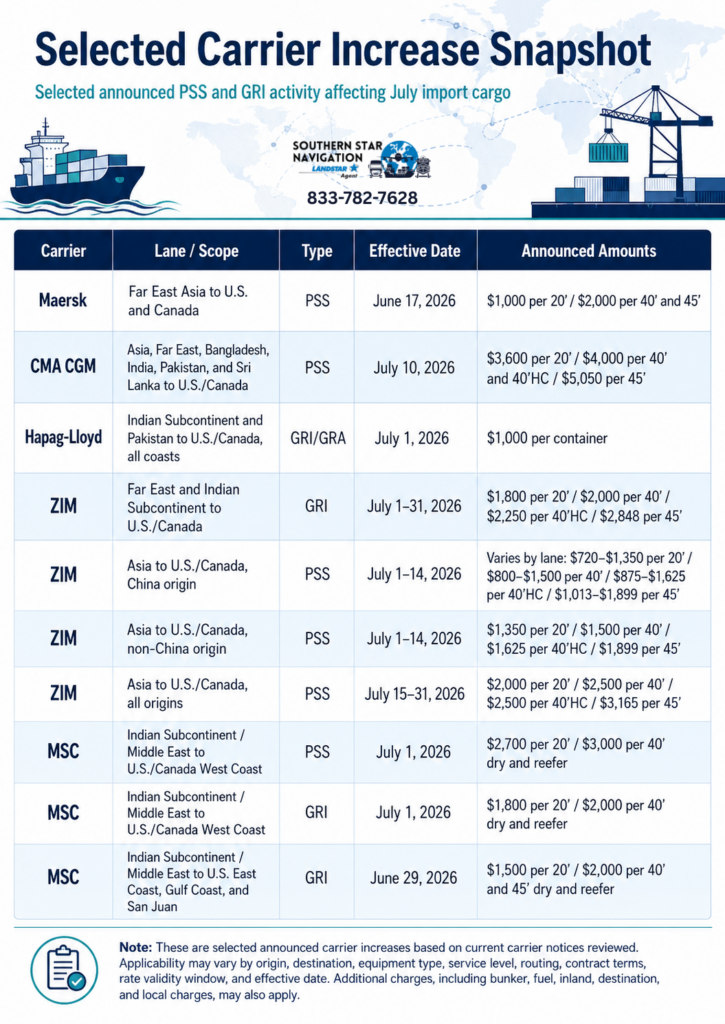
Several carriers have announced Peak Season Surcharges, General Rate Increases, and related adjustments across key import lanes. The snapshot below includes selected examples from current carrier notices reviewed. Actual applicability may vary by origin, destination, equipment type, service level, routing, contract terms, and effective date.
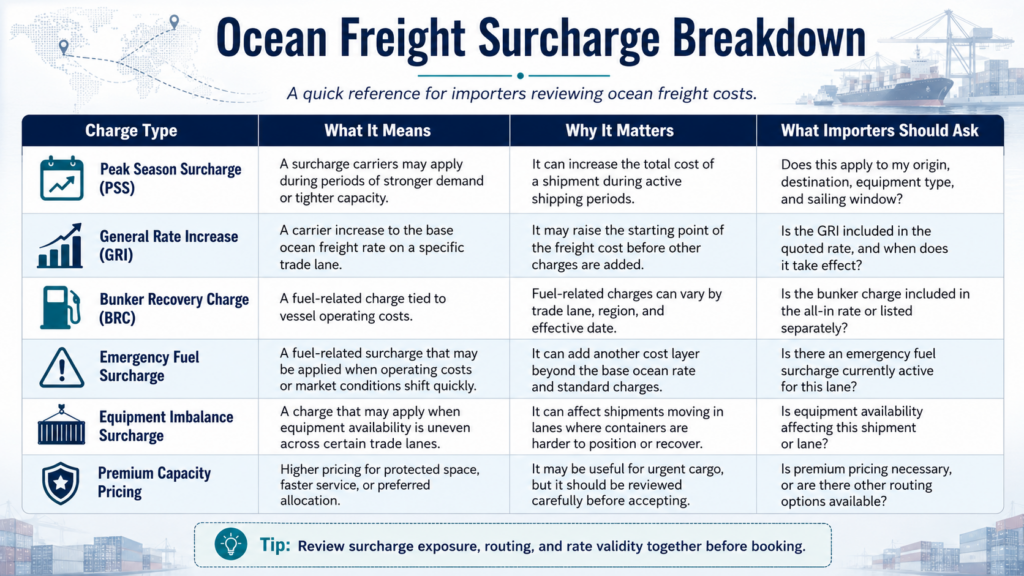
To help make the current surcharge environment easier to understand, the image below breaks down several common ocean freight charges importers may see in current carrier notices.
Fuel and Bunker Charges Add Another Layer
Fuel-related charges are also becoming more important. Carrier notices include bunker recovery charges, quarterly bunker adjustments, monthly bunker charges, and emergency fuel surcharges. These charges are tied to vessel operating costs and can vary by trade lane, region, equipment type, and effective date.
This is one reason importers should avoid comparing quotes based only on the base ocean rate. A lower base rate may not be the better option if the all-in cost is higher after bunker, emergency fuel, peak season, inland, destination, and documentation charges are included.
Fuel-related charges can also affect lanes beyond the most obvious origin markets. Recent notices include activity tied to Asia, the Indian Subcontinent, the Middle East, Africa, South America, Oceania, and other regions moving into the United States. That means importers should not assume the current surcharge environment is limited to one country or one trade lane.
The goal is not to assume every shipment will see the same cost impact, but to understand which lanes, dates, and service options may be affected before decisions are made.
Short Rate Windows Require Faster Review
Another important issue is the length of the rate window. Some current market pricing is only valid for a short period. When rate validity is short, timing becomes more important.
A container expected to move under one rate may fall into a different window if production is delayed, documents aren’t ready, the booking is rolled, cargo misses the intended sailing, or the shipment gates in after the applicable date. Even a small delay can affect cost when rate changes and surcharge effective dates are close together.
Importers should review upcoming purchase orders early and identify which shipments are urgent, which ones are flexible, and which ones may need alternate routing. The earlier the shipment is reviewed, the more options may be available.
Why Routing Strategy Matters
The best routing isn’t always the lowest ocean rate. A routing decision should consider cost, transit time, reliability, inland movement, delivery requirements, and the risk of delay.
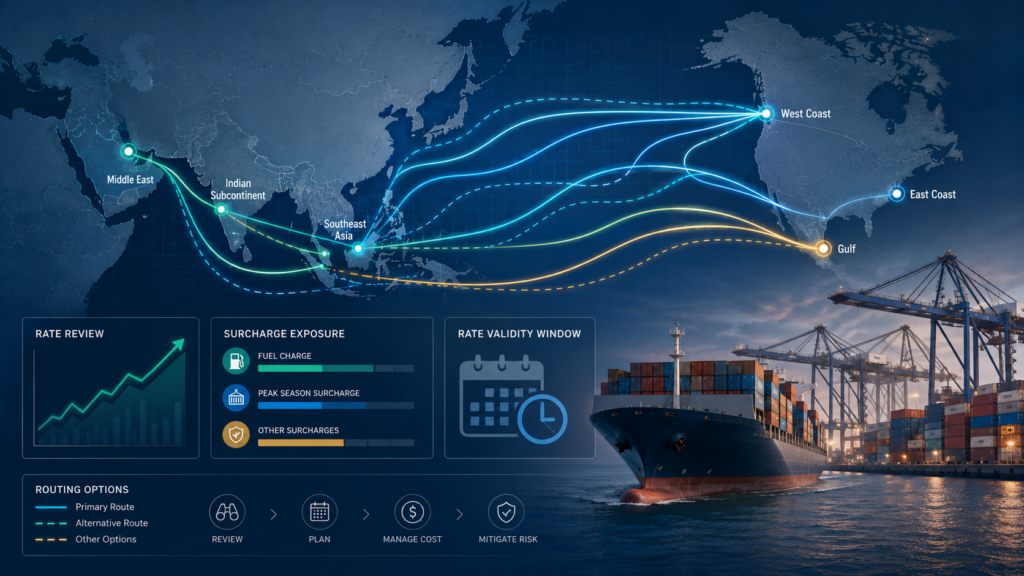
For example, a shipment moving through a West Coast port may offer one type of cost and transit profile. An all-water service to the East Coast or Gulf may offer another. An inland rail move may create different timing and surcharge considerations than a port delivery. A time-sensitive shipment may justify a different service option than cargo with flexible delivery timing.
This is where strategy matters. Importers should compare the full movement, not just the ocean portion. Ocean, rail, truck, warehouse timing, customer delivery dates, and final-mile requirements all affect the best decision.
A Stronger Planning Conversation for Importers
Importers with July or August cargo should review their upcoming shipments before bookings are finalized. A good review should include origin, destination, port pair, inland routing, equipment size, cargo type, delivery timing, rate validity, and known or pending surcharges.
It is also important to communicate internally. Purchasing, finance, sales, warehouse, and customer service teams should understand when freight costs are moving. If landed cost changes after customer pricing is set, margins can be affected. If delivery timing changes, customer commitments and inventory planning can also be affected.
This is not only a freight conversation. It is a business planning conversation.

How Southern Star Navigation Can Help
Southern Star Navigation can help importers review their lanes and routing before cargo moves. The goal is to help companies understand the full shipment picture, compare options, and make informed decisions before the container is already in motion.
A lane review can include surcharge exposure, rate validity, port options, inland routing, equipment needs, timing, and service level. For some shipments, the best strategy may be to move quickly before the next rate window. For others, it may be better to compare alternate routing, adjust timing, or confirm whether premium pricing is necessary. When the market is moving, importers need more than a spot quote. They need clear communication, practical options, and a logistics partner who can help review the details before they become costly surprises.
Ocean freight rate hikes don’t have to catch importers off guard. Current carrier activity, fuel-related costs, and geopolitical uncertainty make it important to review upcoming shipments early and understand what is included in the rate before booking. If you have import cargo moving in July or August, now is the time to review your lanes, confirm rate validity, evaluate routing options, and understand surcharge exposure before cargo is booked.
For help reviewing your import lanes and ocean freight strategy, contact Southern Star Navigation at 833-782-7628 Ext. 1 or schedule a consultation.