

Freight Market and Customs Updates for Importers
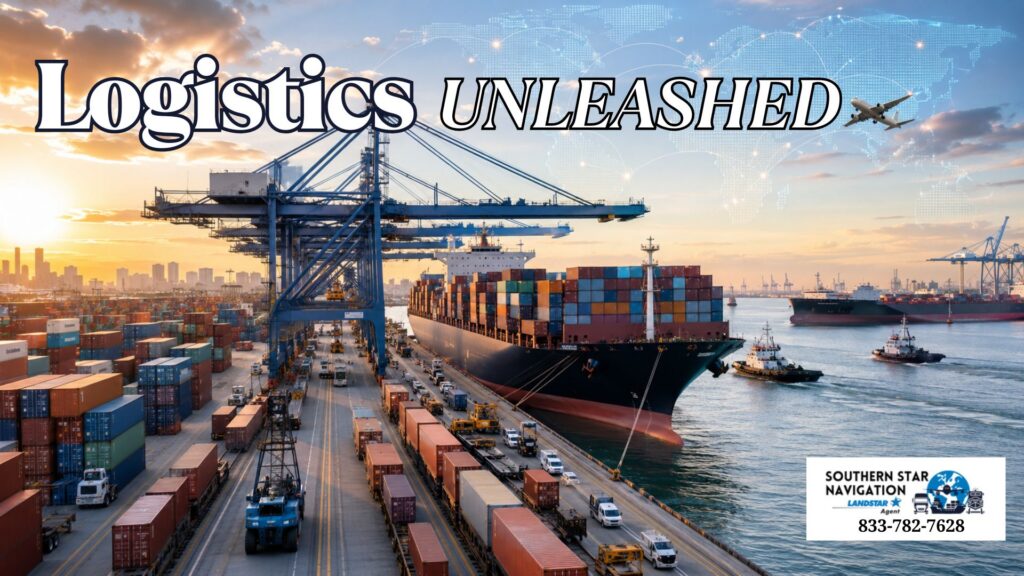
Import Activity Points to an Earlier Peak Season
Import activity is showing signs of moving earlier than usual this year, with many U.S. importers watching tariff timing, fuel-related charges, carrier rate changes, and global disruption risk at the same time. Recent market indicators point to stronger import momentum through major U.S. gateways, especially on West Coast lanes where cargo owners may be trying to move freight before additional cost changes or timing pressures develop.
One of the biggest takeaways is that importers appear to be planning around known deadlines and cost exposure rather than waiting for the traditional late-summer peak. Some cargo may be moving earlier because companies are replenishing inventory, trying to protect landed cost assumptions, or working around uncertainty tied to tariffs, fuel surcharges, and geopolitical disruption. When several cost and timing factors are active at once, shipment planning becomes more important than simply watching the base ocean rate.
This type of environment can affect more than the ocean freight line item. Port selection, inland rail, drayage, equipment availability, transit time, rate validity windows, and final delivery timing can all influence the final all-in cost. Even when cargo is not directly moving through a disrupted region, global vessel capacity, fuel pricing, and carrier surcharge activity can still affect import planning.
For companies with July and August cargo, the best approach is to review lanes early, confirm what is included in the quoted rate, and understand when the rate expires. If a shipment is tied to seasonal inventory, customer delivery commitments, or tariff-sensitive timing, waiting too long may reduce available routing options.
Southern Star Navigation continues to monitor international freight conditions, carrier activity, and routing considerations so importers can make informed decisions before cargo moves. If upcoming cargo may be affected by timing, rate changes, or lane-specific routing decisions, now is a good time to review the plan before capacity and cost pressures become harder to manage.

Truckload Market Shows Signs of Recovery Across Uneven Lanes
The truckload market is showing signs of recovery, but the improvement is not spreading evenly across every region, lane, or industry. Some sectors are seeing stronger freight demand, while others remain softer due to interest rates, uneven manufacturing activity, and slower housing-related freight. Public market commentary also points to stronger activity in certain pockets of the economy, including technology-related supply chains, while more traditional freight sectors continue to move at a slower pace.
For shippers, the key takeaway is that truckload planning should be lane-specific. A rate that looks soft in one market may not reflect conditions in another, especially when freight is tied to ports, intermodal ramps, seasonal inventory, construction activity, retail replenishment, or time-sensitive delivery. As summer import activity develops, reviewing truckload, drayage, rail, and final delivery options early can help reduce cost surprises and protect delivery windows.
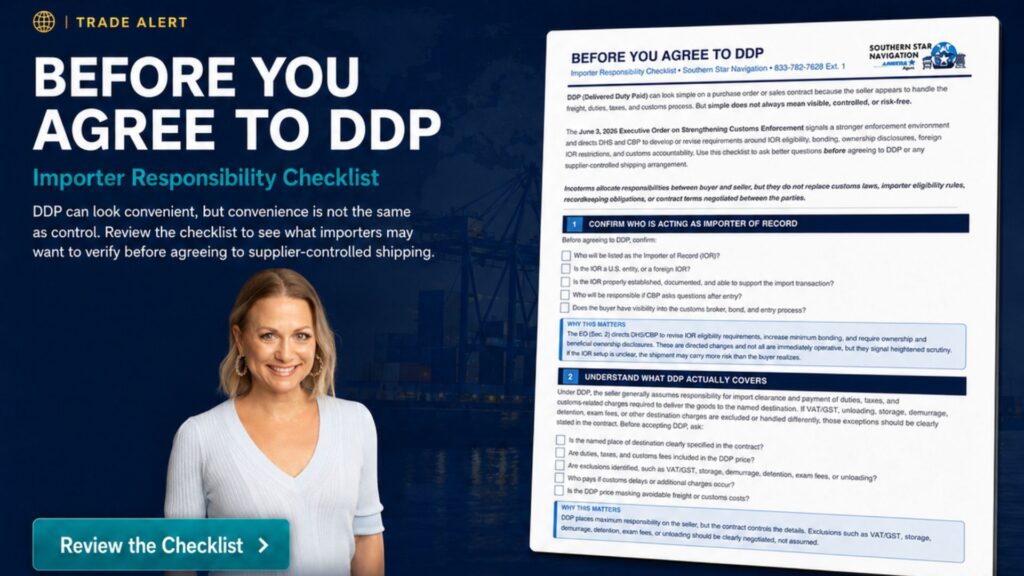
Before You Agree to DDP
DDP, or Delivered Duty Paid, can look simple on a purchase order or sales contract because the seller appears to handle the freight, duties, taxes, and customs process. But simple does not always mean visible, controlled, or cost-effective. Before agreeing to DDP or any supplier-controlled shipping arrangement, importers should understand who is acting as Importer of Record, who controls the customs documentation, who communicates with the broker, and who is responsible if additional charges or CBP questions come up.
With customs enforcement moving toward more importer accountability and documentation visibility, now is a good time to review how DDP arrangements are being managed before cargo moves. Southern Star Navigation created a DDP Importer Responsibility Checklist to help importers ask better questions about IOR setup, duties and taxes, broker visibility, documentation, foreign IOR exposure, and control versus convenience. Click here to download the checklist.

Rail and Intermodal Stay in Focus as Trucking Costs Rise
Rail and intermodal are becoming more important discussion points as shippers look for ways to manage inland transportation costs. When truckload rates rise or capacity becomes less predictable, some companies begin reviewing whether certain lanes could move more efficiently through rail or intermodal service. Intermodal is not always the fastest option, but it can be useful when freight has enough lead time, consistent volume, and a destination that fits the rail network.
At the same time, the proposed Union Pacific and Norfolk Southern merger remains an important rail development to watch. The Surface Transportation Board has accepted the revised major merger application for consideration, but the review process is currently paused while additional information is requested. For shippers, this is not an immediate operational change, but it is a reminder that rail network structure, service reliability, gateway access, and routing options remain important factors in long-term freight planning.

Airfreight Remains a Selective Option for Time-Sensitive Cargo
Airfreight remains a watch point for shippers with urgent, high-value, or time-sensitive cargo, especially as ocean freight rates, fuel-related charges, and geopolitical risk continue to influence transportation planning. Current market activity shows that airfreight is not moving evenly across every lane. Some lanes remain elevated or active, while others are shifting week to week based on capacity, demand, regional disruption, and how quickly cargo needs to move.
For shippers deciding between air and ocean, the question should not only be speed. It should also include inventory urgency, customer delivery commitments, product value, and whether a delay would create a larger business cost than the freight itself. In some cases, a split strategy may make sense, with the most urgent portion moving by air while the balance moves by ocean. Reviewing options early can help avoid last-minute premium decisions when timing becomes critical.

EU Customs Rules Shift for Low-Value Parcels
The EU is moving forward with a major change for low-value e-commerce imports. Beginning July 1, 2026, the current customs duty relief for imported consignments valued at €150 or less will be removed and replaced with a temporary €3 customs duty per item category in the parcel. This is not simply a flat fee per package. If one parcel contains goods that fall under multiple tariff classifications, the €3 charge may apply more than once. The temporary duty is expected to remain in place until July 1, 2028, when the EU Customs Data Hub is scheduled to support the broader e-commerce customs reform.
For companies selling into the EU through e-commerce or distance-sale channels, the practical takeaway is to review product classifications, parcel mix, marketplace/IOSS processes, and fulfillment strategy before peak season. Beginning July 1, costs may be tied more closely to how products are classified and grouped within a parcel, rather than only the parcel’s total value. Product identifiers will also become mandatory beginning November 1, 2026, adding another layer of data accuracy and traceability for distance-sale imports. This is a good time for exporters, e-commerce sellers, and fulfillment teams to confirm that product data, descriptions, classifications, and customs documentation are ready before shipments move.

CBP Expands CAPE Functionality for Reconciliation-Flagged Entries
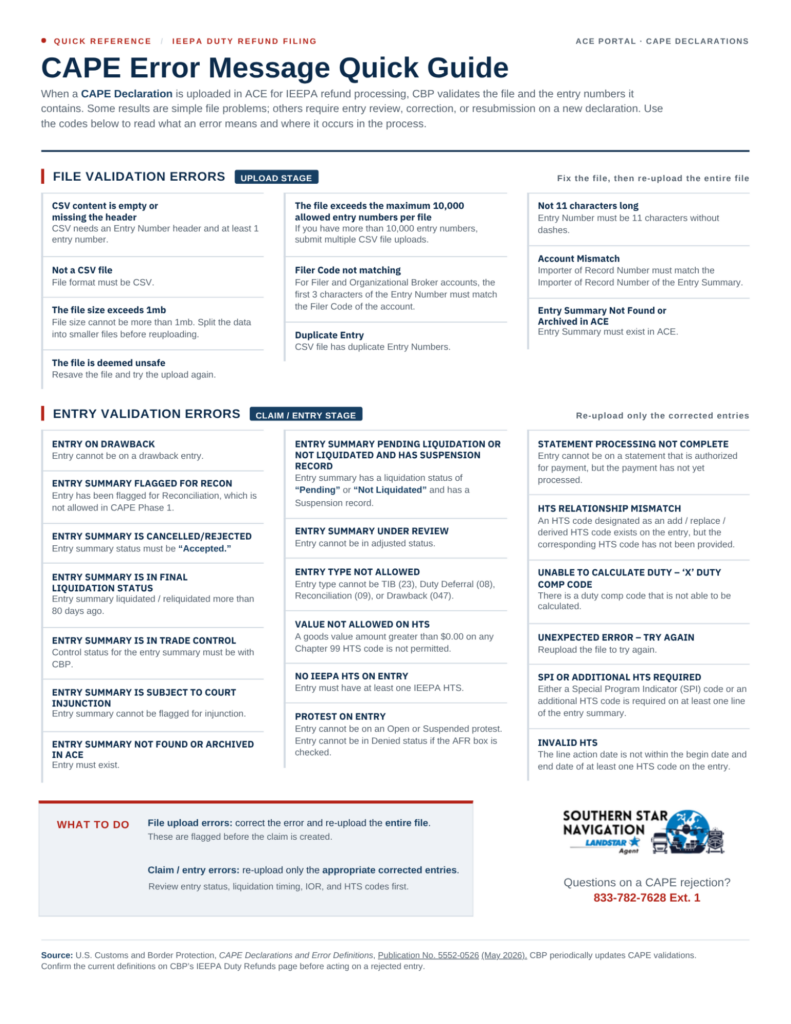
CBP has issued a new CSMS update for the Consolidated Administration and Processing of Entries, known as CAPE, for IEEPA duty refunds. Effective June 29, 2026, CAPE will accept certain entries flagged for reconciliation when the reconciliation entry has not yet been filed. This applies to eligible entry types 01, 02, and 06, and the same Phase 1 limitations remain in place: entries must be unliquidated or within 80 days of liquidation. Once those reconciliation-flagged entries are accepted in CAPE, the trade may proceed with filing the reconciliation entry, with the IEEPA duty refund handled separately from the reconciliation calculations.
One important clarification is that entries already covered by a filed reconciliation entry are not included in this June 29 deployment. CBP stated those entries will be addressed in a future CAPE phase. CBP also noted that the CAPE process does not prevent an entry from being reconciled, so if a reconciliation deadline is approaching, the trade should prioritize the reconciliation filing. CBP states that Phase 1 filing and processing requirements remain in effect, while June 29 adds functionality for certain reconciliation-flagged entries where the reconciliation entry has not yet been filed. Importers with potential IEEPA refund exposure should continue reviewing eligibility, liquidation timing, reconciliation status, and filing deadlines carefully. CBP also issued a follow-up CAPE update addressing certain entry-level validations. According to the update, entries that previously triggered specific CAPE error messages may need to be resubmitted on a new CAPE Declaration, and some HTS-related validations have been narrowed or clarified. Importers and filers working through IEEPA refund claims should continue reviewing CAPE error messages carefully and confirm whether a rejected entry requires correction, PSC action, or resubmission. Read CSMS #69035485
CBP Moves Forward With De Minimis Suspension Rules

CBP published new Federal Register rules addressing the indefinite suspension of the de minimis administrative exemption for imports valued at $800 or less. One rule applies to merchandise arriving through the international postal network, while a second rule applies to merchandise arriving through all other modes. For non-postal shipments, CBP states that low-value merchandise that would have previously qualified for the de minimis exemption must now use formal or informal entry procedures. For postal shipments, CBP is also establishing a new postal informal entry process to support the continued movement and processing of eligible low-value mail shipments. The non-postal rule is effective June 24, 2026, while the postal rule generally takes effect July 24, 2026, with certain compliance dates extending to October 22, 2026.
CBP also announced a test for a new electronic informal mail entry process using entry type 13, Informal Mail Entry, for eligible international mail shipments valued at $2,500 or less. For importers, e-commerce businesses, and companies using parcel, postal, or other low-value shipment channels, the key takeaway is that low-value does not mean no-entry or no-duty. Businesses should continue reviewing classification, country of origin, declared value, data quality, duty exposure, and whether a shipment should move under a formal or informal entry process. Southern Star Navigation will continue monitoring CBP updates as the new postal informal entry process and related filing requirements move forward. Read More