
The Trade Flow Map: How Global Trade Decisions Impact Cash Flow and Compliance
Most companies think about logistics as moving freight from point A to point B.
But in global trade, every shipment also moves money.
From product classification to final delivery, each step in the trade process impacts duties, working capital, compliance exposure, and long-term profitability. When these pieces are aligned, trade flows smoothly. When they are not, small errors can turn into delays, penalties, unexpected duties, and tied-up capital.
That is why more importers and exporters are looking beyond transportation rates and focusing on global trade cash flow management.
The Trade Flow Map was designed to make that full journey visible.
Why Global Trade Cash Flow Management Matters
In today’s environment, tariffs, customs scrutiny, and valuation rules continue to evolve. Companies that treat logistics strictly as a shipping function often discover that financial exposure is hiding in areas they did not expect.
Key areas that directly impact cash flow include:
• Product classification and HTS accuracy
• Country of origin validation
• Customs valuation and invoice structure
• Duty strategy and drawback eligibility
• Compliance documentation and record retention
• Multimodal transit timing and port performance
Each one of these elements influences landed cost and financial predictability.
When classification is incorrect, duties may be overpaid or underpaid. When valuation does not reflect transaction value properly, audits become more likely. When customs release documentation is incomplete, cargo can sit — increasing demurrage, storage, and cash tied up in inventory.
Global trade is not only about freight movement. It is about financial structure.
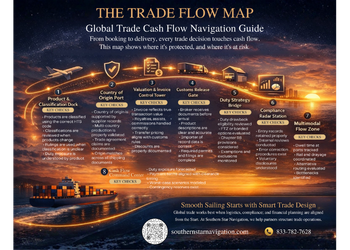
The Eight Stages of the Trade Flow Map
The Trade Flow Map outlines the full journey most shipments take:
1. Product Classification Dock
Using the correct HTS code is foundational. Classification determines duty rates, Section 301 exposure, Section 232 applicability, and eligibility for trade agreements.
2. Country of Origin Port
Country of origin must be supported by supplier records and properly reflected across all shipping documents. Errors here affect duty rates and trade agreement claims.
3. Valuation and Invoice Control
Transaction value, royalties, assists, transfer pricing, and commissions must align with customs rules. Proper valuation protects against post-entry adjustments and penalties.
4. Customs Release Gate
Brokers require complete and accurate documentation before arrival. Delays at this stage can impact port dwell time and inventory availability.
5. Duty Strategy Bridge
Drawback, FTZ options, bonded strategies, and Chapter 98 provisions should be evaluated in advance, not after duties are paid.
6. Compliance Radar Station
Entry records, internal reviews, and correction procedures reduce long-term audit exposure.
7. Multimodal Flow Zone
Rail, drayage, alternative routing, and bottleneck awareness influence total landed cost and reliability.
8. Cash Flow Command Center
Payment terms, clearance timing, and contingency planning ultimately determine how predictable trade really is.
Each stage touches cost, compliance, or working capital.
From Shipment Management to Trade Design
Many companies focus on negotiating freight rates. While rates matter, they are only one piece of landed cost analysis.
A well-structured trade strategy considers:
• Predictable customs clearance
• Accurate duty forecasting
• Proper documentation from origin
• Financial modeling of worst-case scenarios
• Alignment between operations and accounting
This shift from reactive shipping management to proactive trade compliance strategy reduces volatility and protects margins.
It also supports better conversations internally between logistics, finance, and executive leadership.
How the Trade Flow Map Helps
The Trade Flow Map provides a visual framework for evaluating where risk and opportunity exist across your supply chain.
Instead of reviewing shipments one at a time, companies can step back and ask:
• Where could duties be miscalculated?
• Are we aligned with customs valuation requirements?
• Are our compliance procedures documented and reviewed?
• Do we understand how port dwell time affects cash flow?
• Have we modeled tariff impact on landed cost?
These are not theoretical questions. They directly influence profitability.
A More Predictable Approach to International Freight
At Southern Star Navigation, we help partners evaluate their trade structure, not just their shipments.
That includes reviewing classification accuracy, country of origin documentation, customs valuation alignment, duty planning opportunities, and multimodal routing strategy.
The goal is not complexity.
The goal is predictability.
When trade systems are designed correctly from the beginning, companies experience:
• Fewer clearance delays
• Lower risk of penalties
• More accurate landed cost forecasting
• Improved working capital visibility
• Greater operational stability
In global trade, clarity is a competitive advantage.
Download The Trade Flow Map
You can download the full Trade Flow Map guide and watch the short overview video above.
If you would like a brief review of how your current trade flow aligns with these stages, you can also request a short working session to walk through your lanes and compliance structure.
Global trade works best when logistics, compliance, and financial planning are aligned from the start.
Smooth sailing begins with smart trade design.