
CBP Foreign IOR Requirements and Transshipment Enforcement: What Importers Should Know
To Our Valued Partners,
As a follow-up to our June 10 customer advisory on Executive Order 14411, Strengthening Customs Enforcement, two new developments provide additional insight into where U.S. customs enforcement is heading. On August 12, U.S. Customs and Border Protection (CBP) issued a CTPAT Alert with new details about upcoming requirements for foreign Importers of Record (IORs) and CTPAT-Validated Customs Brokers. Today, August 13, the White House also released a new report focused on illegal transshipment, country-of-origin shifting, and tariff evasion through third countries.
Foreign IOR Requirements Are Becoming Clearer
Under Executive Order 14411, foreign IORs will be required to be CTPAT validated or use a licensed CTPAT-Validated Customs Broker to file entries with CBP. The August 12 CTPAT Alert explains that CBP is preparing to revise importer eligibility regulations, policies, and guidance to implement these requirements. CBP also says CTPAT-Validated Customs Brokers will be expected to perform more comprehensive vetting of foreign IOR clients before conducting customs business for them.
CBP identified several areas brokers are expected to review, including:
- Legal identity and ownership structure
- Business affiliations and U.S. assets
- Import and compliance history
- Ability to pay duties, taxes, and fees
- Supply chain information
- Product classification
- Valuation
- Country of origin
Brokers will also be expected to maintain records showing the due diligence they performed, including powers of attorney and relevant communications.
Importer “Good Standing” Will Also Matter
Executive Order 14411 also directs CBP to establish a “good standing” requirement that will apply to Importers of Record more broadly. The August 12 alert explains that an IOR that loses good standing could ultimately be prohibited from importing goods or designating a customs broker to act on its behalf. CBP is still developing the regulatory requirements, so the alert does not establish a final implementation date.
The alert also makes clear that broker due diligence will carry consequences. CBP says brokers that fail to perform required due diligence, repeatedly represent non-compliant or unverifiable clients, or fail to cooperate with information requests may face financial penalties, increased audits, and possible suspension or removal from the CTPAT program.
Transshipment and Country of Origin Are Receiving More Attention
Today, August 13 the White House report expands the enforcement discussion beyond foreign IORs and focuses heavily on illegal transshipment and country-of-origin claims. It describes practices such as relabeling, repackaging, re-invoicing, limited processing, false origin claims, and routing goods through third countries in an effort to obtain tariff treatment that would not apply based on the goods’ actual origin.
The report identifies more than 40 jurisdictions associated with elevated illegal-transshipment risk and groups them into three broad tiers:
- Tier 1 – Diversified Scale Leaders: Canada, the European Union, India, Israel, Japan, Mexico, South Korea, and Taiwan
- Tier 2 – Scale Leaders with Significant Economic Integration with China: Brazil, Indonesia, Malaysia, Thailand, Turkey, and Vietnam
- Tier 3 – Smaller Opportunistic Jurisdictions: a larger group that includes countries with factors such as free-trade zones, bonded warehousing, port access, lower-cost assembly, re-export activity, or more limited customs capacity
Importantly, being identified in one of these categories does not mean merchandise from that country is presumed to be illegally transshipped. The report acknowledges that changes in sourcing can result from legitimate manufacturing, investment, and supply chain shifts. For importers, the important question is whether the reported country of origin and tariff treatment can be supported by the actual production process, applicable origin rules, and documentation behind the transaction.
What Enforcement May Look At
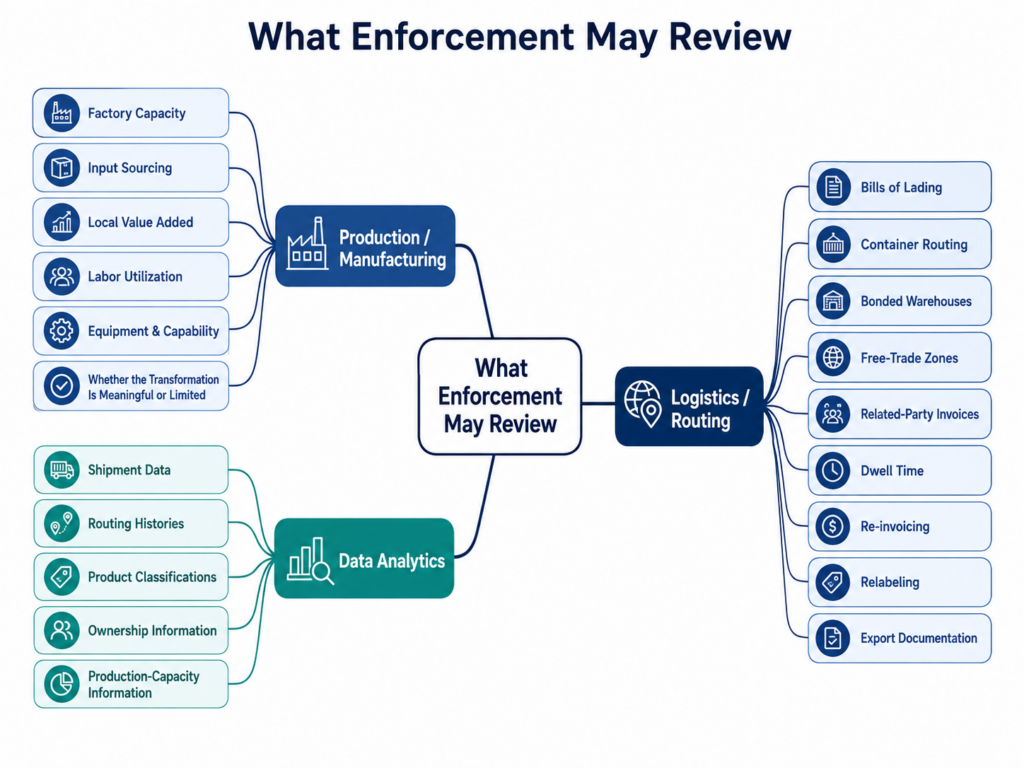
The report provides a useful look at the types of information that may receive closer review.
For production and manufacturing activity, that may include:
- Factory capacity
- Input sourcing
- Local value added
- Labor utilization
- Equipment and production capability
- Whether the claimed transformation reflects meaningful production or only limited processing
For logistics and routing activity, review may include:
- Bills of lading
- Container routing
- Bonded warehouses
- Free-trade zones
- Related-party invoices
- Dwell time
- Re-invoicing
- Relabeling
- Export documentation
The report also discusses the use of shipment data, routing histories, product classifications, ownership relationships, production-capacity information, and other analytics to identify unusual patterns. For importers, this reinforces the importance of having documentation that tells the same story as the entry data submitted to CBP.
Enforcement Activity Is Already Increasing
The report also points to a significant increase in post-release enforcement activity. Comparing the two 526-day periods described in the report, shipments identified with post-release discrepancies increased 245%, from 93,744 to 323,677. Associated revenue assessments increased 169%, from $9.6 billion to $25.8 billion.
Those figures do not mean every importer or shipment is facing increased scrutiny, but they do show that CBP’s post-entry review and revenue-enforcement activity has increased significantly. Combined with the coming foreign-IOR requirements and the government’s increased focus on transshipment, importers should expect documentation, origin, valuation, classification, and importer information to remain important areas of compliance.
What Importers Can Review Now
Importers do not need to wait for a final implementation date to review their current setup. Companies using foreign IOR arrangements, DDP terms, supplier-controlled import programs, China-origin inputs, or third-country manufacturing should consider reviewing:
- Who is acting as the Importer of Record
- Whether foreign IOR and DDP responsibilities are clearly defined
- Ownership and company information
- Bond arrangements
- Product classification
- Valuation
- Country-of-origin support
- Supplier and manufacturing records
- Supply chain documentation
- Powers of attorney and broker communications
For goods that move through or undergo processing in a third country, importers should also be able to explain what manufacturing actually occurred there and why the declared origin is correct. Documentation should support the production steps, components used, supplier relationships, value added, and movement of the goods through the supply chain.
What Has Not Changed Yet
Neither the August 12 CTPAT Alert nor the August 13 transshipment report establishes a new tariff or a final effective date for the upcoming foreign-IOR requirements. CBP still must complete additional regulatory and implementation work before those requirements take effect. The new releases do, however, provide a much clearer picture of the direction of customs enforcement and the information importers and brokers may increasingly be expected to support.
Southern Star Navigation will continue monitoring CBP’s implementation of Executive Order 14411 and related enforcement developments. We will share additional information as CBP announces specific procedures, requirements, and effective dates.
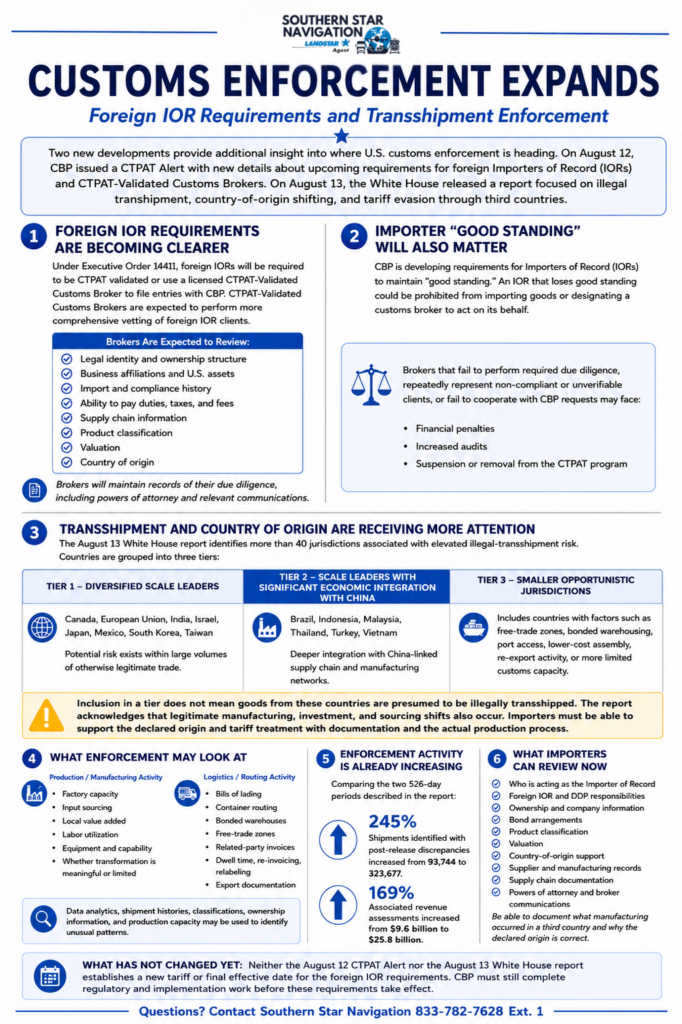
View the quick-reference guide below or click the image to download the full-size PDF.
RESOURCES
- Our June 10 Customer Advisory: Strengthening Customs Enforcement
- CBP: CTPAT Alerts and Bulletins
- White House Report: The Great Transshipment Scam
- CBP: Strengthening Customs Enforcement
- Executive Order 14411: Strengthening Customs Enforcement
If these upcoming changes raise questions about your current import process, foreign IOR arrangements, documentation flow, country-of-origin support, or customs brokerage coordination, please contact Southern Star Navigation at 833-782-7628